What Does "Organic" Actually Mean on a Turmeric Powder Label?
"Organic" gets printed on spice packaging so often that it's easy to forget it's supposed to mean something specific. For turmeric powder, a genuine organic claim means the rhizome was grown without synthetic pesticides, synthetic fertilizers, or genetically modified inputs, typically following a multi-year transition period on the farm before certification is granted — and that the claim has been checked and signed off by an accredited third-party body, not just written on a bag by whoever packed it.
That certification also has to survive the journey from field to jar. A farm can be organically managed and still lose the claim if the turmeric is later processed, stored, or packed alongside conventional stock without a documented separation. This is why real organic certification covers the whole chain of custody — growing, drying, grinding, and packing — rather than just the soil the rhizome came out of.
This guide walks through what that certification should look like in practice, how curcumin content fits into the picture, and what to check before you commit to a jar, a case, or a bulk order. If you want a deeper look at Lakadong turmeric specifically — its origin, GI tag, and everyday use — see our Lakadong turmeric powder guide and organic Lakadong turmeric powder guide. For sourcing turmeric at wholesale volume, our Meghalaya supplier guide covers that side in detail.
The word "organic" printed on packaging carries no weight on its own. What matters is whether there's an actual certificate number behind it, issued by a recognised body such as an NPOP-accredited certifier in India or a USDA-accredited agent in the US. If a seller can't produce that number, the claim hasn't been verified — no matter how confidently it's written on the label.
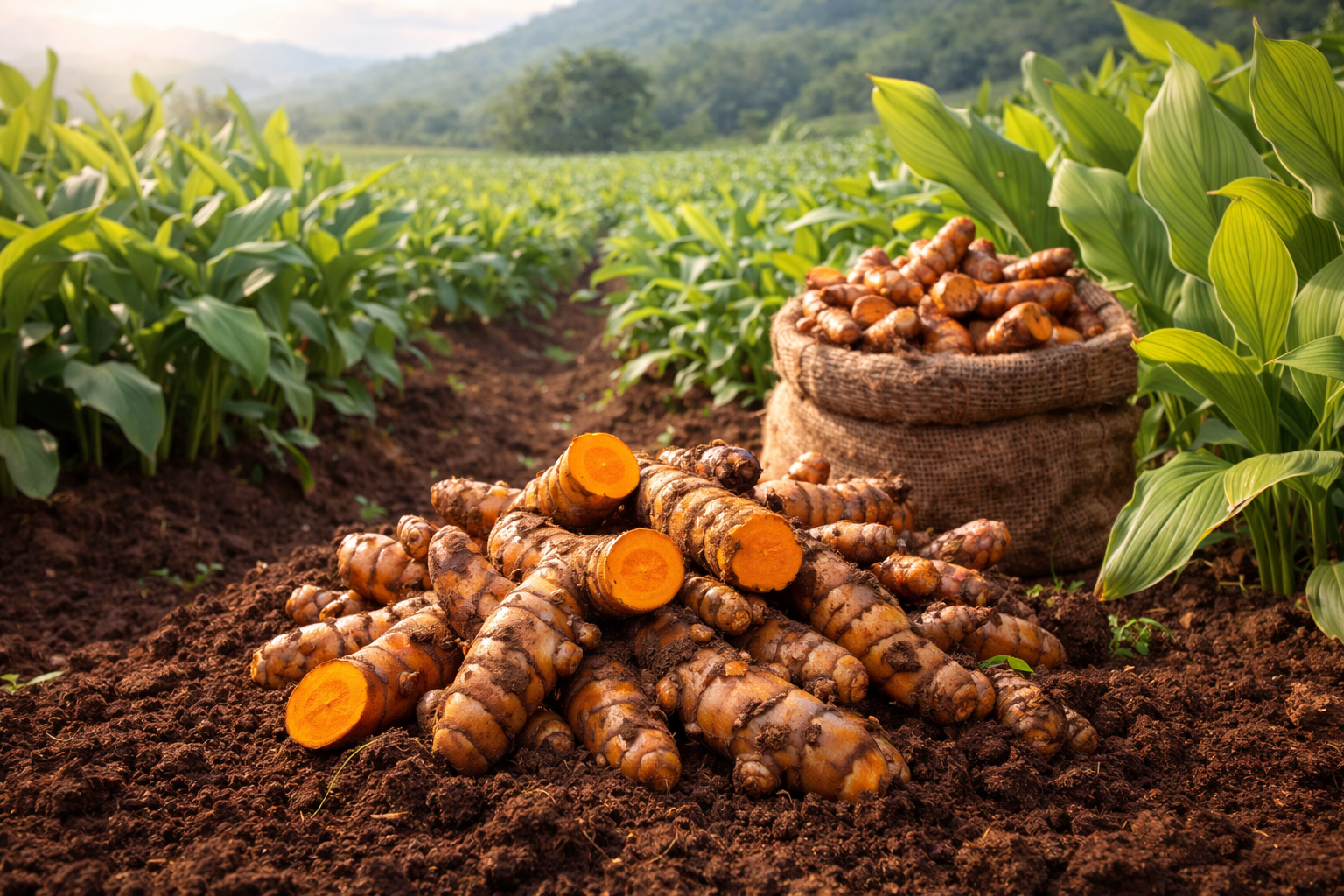
Rhizome from a certified-organic plot in the Jaintia Hills — the starting point for a turmeric powder claim that can actually be traced and verified.
Why Organic Farming Affects Curcumin Content — And Why It Isn't the Whole Story
Turmeric grown without synthetic fertilizers tends to mature more slowly, drawing nutrients from compost and natural soil biology rather than being pushed toward rapid growth. Slower, less forced growth is one of several factors — alongside variety, altitude, and rainfall — that can support stronger curcumin development in the finished rhizome. Jaintia Hills' particular soil and altitude profile is one reason Lakadong turmeric has built a reputation for naturally high curcumin, independent of certification status.
Here's the part buyers often get backwards: organic certification and curcumin percentage are two separate things, confirmed by two separate processes, and a high number on one doesn't guarantee a high number on the other.
In practice, the two often go together at a good supplier simply because a farm careful enough to maintain organic certification is usually also careful about harvest timing and drying — but they should still be checked as two separate line items, not assumed from one another.
"Organic" vs "Natural" vs "Pure" — Which Label Terms Actually Mean Something?
Turmeric packaging is crowded with reassuring words, and only a handful of them are backed by any enforceable standard. Here's how the common ones stack up.
| Label Term | Legally Regulated? | What It Actually Confirms | What To Verify |
|---|---|---|---|
| Certified Organic (NPOP / USDA NOP) | Yes | Grown & processed without prohibited synthetic inputs, audited annually | Certificate number, issuing body, validity date |
| GI Tagged (e.g. Lakadong, GI No. 741) | Yes, government-registered | Regional origin authenticity — a separate claim from organic status | GI registration reference |
| "Natural" | No | Nothing enforceable — an unregulated marketing term | Ask the seller directly what they mean by it |
| "Pure" / "100% Turmeric" | No | Only meaningful if the ingredient list confirms no additives | Read the ingredient list, not the front-of-pack claim |
| "Non-GMO" | Varies by market | Turmeric is rarely genetically modified regardless of this label | Rarely a meaningful differentiator for this crop |
Some packaging leans on organic-adjacent language — "grown naturally," "chemical-free farming," "traditional cultivation" — without ever using the certified word or a certificate number. These phrases can be entirely true and still fall short of an audited organic claim. If organic status matters for your purchase, look specifically for a certificate number, not a phrase that sounds like one.
How Organic Turmeric Powder Is Made — Without Synthetic Shortcuts
Knowing the stages a batch actually passes through makes it much easier to ask a supplier specific questions instead of vague ones.
Certifications Worth Checking Before You Buy Organic Turmeric Powder
A confident sales page is easy to write. A certificate number that checks out against an issuing body's own records is harder to fake — which is exactly why it's worth asking for by name.
India's National Programme for Organic Production. Look for the certifying agency's name and a certificate number you can independently check, not just the acronym printed on a bag.
India organic standardRequired if a product is marketed as "USDA Organic" in the US. Confirm the accredited certifying agent named on the seal, since the seal alone isn't the certificate.
US organic standardA regional-origin claim like Lakadong's GI Tag No. 741 is separate from organic status — one confirms where it's from, the other confirms how it was grown.
Origin authenticityA batch-specific Certificate of Analysis showing curcumin percentage via HPLC — the only real confirmation of potency, as opposed to a number quoted from memory.
Verifies potencyIndia's food safety license, required for any food-grade turmeric moving through the domestic supply chain, organic or otherwise.
Food safetyOrganic certificates are renewed annually. A certificate number that's expired or unrenewed is, in practical terms, no longer a valid organic claim.
Easy to overlookAsk directly for the certifying body's name and the certificate number, and check it against that body's own public records where available. A supplier confident in their certification will hand this over without hesitation — one relying on the word "organic" alone tends to answer in generalities instead.
Buy Genuine Organic Turmeric Powder Direct From Certified Farms
NPOP & USDA NOP certified · GI Tag No. 741 · NABL-tested 7–12% curcumin · Retail packs, bulk sacks & private label available
Ways People Actually Use Organic Turmeric Powder
Once you've settled on a genuinely certified, well-tested organic turmeric powder, the more interesting question is what to actually do with it day to day.
What Curcumin Percentage Should You Actually Look For?
Curcumin percentage is the single figure that best separates an ordinary turmeric powder from a genuinely premium one — but it should always come from a batch-specific lab test, not a number printed generically across a whole product line.
Approximate curcumin ranges as measured by HPLC — always ask for the batch-specific figure rather than a general product-page claim.
Many widely available turmeric powders sit in the 2–4% range. Careful growing and low-heat processing can push that into the 4–6% "good" band, with well-managed lots reaching 6–9%. Certain high-curcumin varietals — Lakadong turmeric from Meghalaya's Jaintia Hills among them — are tested between 7–12% via HPLC, which is part of why the variety carries its own GI tag separate from turmeric grown elsewhere.
Curcumin can be estimated with cheaper colorimetric methods, but HPLC (high-performance liquid chromatography) is the standard buyers should ask for by name — it's considerably more accurate and is what a NABL-accredited lab will typically use for a proper Certificate of Analysis.
Storing Organic Turmeric Powder Without Losing Potency
Good turmeric powder doesn't spoil in the way fresh produce does, but it does slowly lose colour, aroma, and some curcumin potency with exposure to light, heat, and air. A few simple habits go a long way toward protecting whatever you've paid for.
- 🫙Keep it airtight — transfer to a sealed jar rather than leaving the original bag loosely folded shut.
- 🌑Store away from direct light — a cupboard or pantry rather than an open shelf near a window.
- 🌡️Keep it cool and dry — away from stovetop heat and humidity, both of which accelerate flavour loss.
- 🥄Always use a dry spoon — introduced moisture is one of the fastest ways turmeric powder clumps and degrades.
- 🗓️Expect roughly 18–24 months of good quality when unopened and stored correctly — check the batch date rather than assuming an indefinite shelf life.
How to Spot Adulterated or Overstated "Organic" Turmeric Powder
Organic certification protects how turmeric is grown and handled — it doesn't automatically protect against adulteration introduced later in the supply chain, such as fillers or added colourants. These are the signals worth paying attention to either way.
- Certificate numbers you can actually check against the issuing body's records
- A batch-specific COA with a curcumin percentage tied to a lot number
- Colour that's a warm, slightly muted orange-yellow rather than an unusually vivid shade
- Clear, specific answers about which farms or region the turmeric was grown in
- A supplier willing to explain what a home water test would show for that batch
- "Organic" printed with no certificate number or issuing body named anywhere
- A shade of yellow that seems noticeably brighter than other turmeric you've bought before
- No batch or lot number printed anywhere on the packaging
- Reluctance to share a Certificate of Analysis when asked directly
- Pricing far below every other certified-organic option, with no explanation offered
Stir a small amount of turmeric powder into a glass of cold water. Genuine turmeric settles gradually and tints the water a soft, muted yellow. If the water turns an intensely bright, almost fluorescent orange-yellow right away, or a bright layer forms on top, it's often cited as a possible sign of an added colourant such as metanil yellow. Treat this as a rough home indicator only — a batch-specific Certificate of Analysis from an accredited lab is the only reliable confirmation.
Retail Packs vs Bulk Organic Turmeric Powder — Which Should You Buy?
Individual buyers and businesses tend to need very different things from the same product, and it's worth matching your order to how the turmeric will actually be used rather than defaulting to whatever's listed first.
| Consideration | Retail / Home Use | Bulk / Business Use |
|---|---|---|
| Typical Pack Size | 100g – 1kg resealable pouches | 5kg, 25kg+ export sacks with food-grade liners |
| Documentation Needed | Certificate reference on request | Batch-specific COA and organic certificate per lot |
| Turnover Speed | Slower — buy what you'll use within its shelf life | Faster — plan around processing and production schedules |
| Private Label / OEM | Not usually applicable | Available on qualifying bulk orders |
If you're a café, restaurant, manufacturer, or reseller planning to move meaningful volume, our Meghalaya supplier guide covers MOQs, export documentation, and how to vet a bulk supplier in far more depth than makes sense here.
FAQs — Organic Turmeric Powder
Certified-organic turmeric powder comes from rhizome grown without synthetic pesticides or fertilizers, processed and packed under an audited chain of custody so the claim can be traced back to a specific certified farm and batch. Regular turmeric powder can still be good quality, but it hasn't gone through that certification and audit process, so the growing and handling practices behind it aren't independently verified.
Not automatically. Organic certification confirms how the turmeric was grown and handled, not how much curcumin it contains. Curcumin percentage depends on variety, soil, altitude, and processing, and is only confirmed through a batch-specific HPLC lab test. Organic status and curcumin content are two separate things worth checking independently.
Ask the seller for the actual certificate number and the name of the certifying body — an NPOP-accredited agency in India, or a USDA-accredited certifying agent in the US. A genuine certificate can be checked against that body's own records. If a seller can only repeat the word "organic" without a certificate number attached, the claim hasn't actually been verified.
Many commercially available turmeric powders test in the 2–4% curcumin range. Well-grown and carefully processed stock often reaches 4–6%, with premium lots at 6–9%. Certain high-curcumin varietals, including Lakadong turmeric from Meghalaya's Jaintia Hills, are tested between 7–12% via HPLC. Always ask for the batch-specific figure rather than a number quoted generically on a listing.
Keep it in an airtight container, away from direct sunlight, heat, and moisture, and always use a dry spoon. Stored this way, unopened turmeric powder typically holds its flavour and colour well for around 18–24 months — though both aroma and curcumin content fade gradually with light, heat, and air exposure rather than the product spoiling outright.
Yes. Organic certification covers farming and handling practices, but it doesn't automatically protect against adulteration — such as added colourants or fillers — introduced later in the supply chain. A batch-specific Certificate of Analysis, and informally a simple cold-water colour check at home, are both useful ways to sense-check a product alongside its organic paperwork.
Lakadong Gold Exports maintains NPOP and USDA NOP certification across its Jaintia Hills farm network, alongside GI Tag No. 741 confirming regional origin. Each batch is tested via HPLC for curcumin content, and certification along with the Certificate of Analysis is available on request for both retail and bulk orders.
Organic Turmeric Powder — Quick Buyer's Checklist
Run through this before buying — whether it's a single retail pouch or a repeat bulk order.
- 📜Check for an actual certificate number — NPOP or USDA NOP, not just the word "organic" printed on the pack.
- 🧪Ask for a batch-specific COA with curcumin percentage confirmed via HPLC.
- 🔢Look for a lot or batch number printed somewhere on the packaging.
- 🥛Compare colour and aroma against what's described, and treat the cold-water check as a rough guide, not a replacement for lab data.
- 📦Decide retail vs bulk based on how you'll actually use it, not just the listed price per kilogram.
- 🗓️Confirm shelf life and storage instructions before committing to a larger quantity.
NPOP & USDA NOP certified across our Jaintia Hills farm network · GI Tag No. 741 · NABL-accredited COA per batch (7–12% curcumin via HPLC) · Retail packs, bulk sacks, and private label available · Certification and Certificate of Analysis provided on request with every order · WhatsApp response within 2 hours.