Why the Curcumin Number on a Certificate Isn't a Guess
Almost every Lakadong turmeric listing quotes a curcumin range — usually somewhere between 7% and 12%. What's rarely explained is where that number comes from, or how confident a buyer should be in it. Colour and aroma can tell an experienced trader that a batch is probably high-curcumin, but neither can produce a defensible percentage. That number only exists because a laboratory ran a specific chemical process and measured a specific result.
For a spice that's priced and sold on potency, this matters more than it would for most agricultural products. A pepper is a pepper regardless of its exact piperine content, but Lakadong turmeric's entire market position rests on curcumin percentage — it's the number that separates a premium export lot from an ordinary commodity batch selling for a fraction of the price. Getting that number right, and being able to prove how it was obtained, is what a testing report is actually for.
This matters even more once turmeric crosses a border. Export shipments are frequently re-tested by the importer's own laboratory or a third-party inspection agency on arrival. If the number on the exporter's Certificate of Analysis doesn't hold up under independent testing, the consequence isn't just an awkward email — it can mean a rejected consignment, a renegotiated price, or the end of a buyer relationship. Understanding the testing process is how both sides — exporter and importer — end up trusting the same figure.
Turmeric contains three closely related yellow-orange pigment compounds, collectively called curcuminoids: curcumin, demethoxycurcumin, and bisdemethoxycurcumin. A proper lab report separates and quantifies each one individually, then usually states both the curcumin figure alone and the combined total curcuminoids figure. When a listing simply says "9% curcumin" with no further detail, it's worth asking which of these two numbers is being quoted.
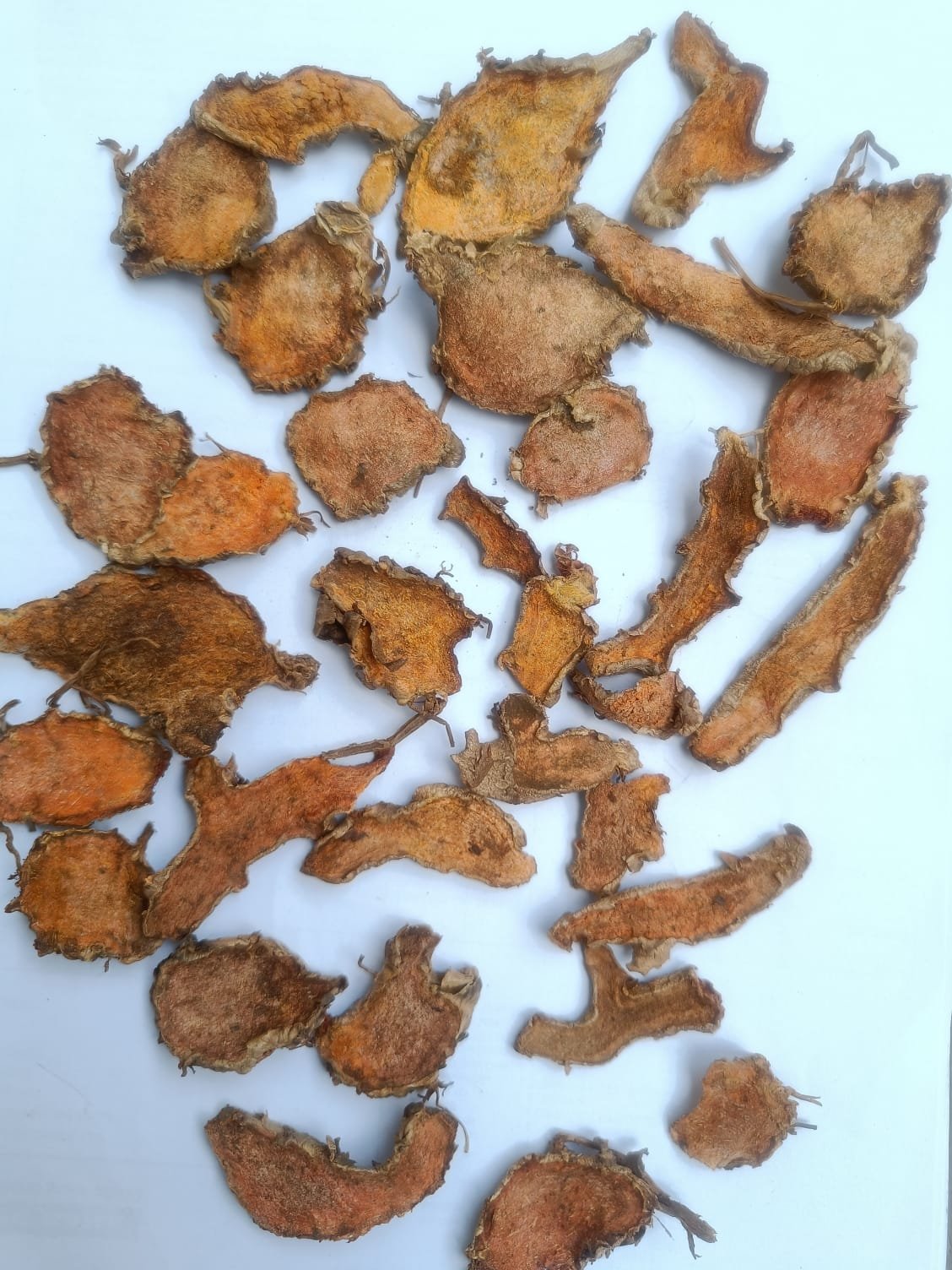
A weighed turmeric sample ready for solvent extraction — the first physical step in converting a bag of powder into a laboratory-verifiable curcumin figure.
Titration, Spectrophotometry, and HPLC — Compared
Curcumin content can be estimated by more than one laboratory method, and they are not interchangeable in accuracy or acceptance. Knowing which method produced a given number changes how much weight that number should carry.
| Method | What It Actually Measures | Precision | Export-Grade? |
|---|---|---|---|
| Iodometric Titration | Rough estimate via chemical reaction endpoint | Low — broad margin of error | No |
| UV-Vis Spectrophotometry | Combined colour absorbance of all curcuminoids together | Moderate — can't isolate individual compounds | Rarely accepted alone |
| HPLC (High Performance Liquid Chromatography) | Curcumin, demethoxycurcumin & bisdemethoxycurcumin measured individually | High — reference-grade | Yes — the accepted standard |
Titration is largely a legacy method at this point — fast and cheap, but too imprecise for anything beyond a rough internal check. Spectrophotometry is faster and cheaper than HPLC and can be genuinely useful for a supplier's own quality screening between batches, but because it reads total pigment colour rather than separating individual compounds, other coloured substances in the sample can distort the result. HPLC is the only one of the three that physically separates each curcuminoid before measuring it, which is why it's the method export buyers, food safety authorities, and reference laboratories generally expect to see named on a COA.
An HPLC system separating the turmeric extract's curcuminoids into distinct peaks — the moment estimation gives way to a measurable, reproducible result.
The output of the whole process: a signed Certificate of Analysis stating the method, the lab's accreditation number, and the batch-specific curcumin result.
How an HPLC Curcumin Test Actually Runs
The lab process behind a single curcumin percentage figure involves several distinct, sequential stages. None of them can be skipped without weakening the reliability of the final number — this is a real chemical procedure, not a scan or a reading taken in seconds.
Why Sampling Decides the Result Before Testing Even Starts
A perfectly run HPLC analysis on a poorly drawn sample still produces an unreliable number. Sampling is the part of curcumin testing that buyers think about the least, and the part that most affects whether a COA actually represents the turmeric they're going to receive.
Turmeric within a single lot is rarely perfectly uniform. Rhizomes harvested slightly earlier or later, dried for a few hours longer, or sourced from a different section of the same farm can carry meaningfully different curcumin levels. Test only one bag from a hundred-bag lot, and the certificate reflects that one bag — not the shipment. This is why credible labs and export suppliers draw composite samples from multiple points across the lot, mix them thoroughly, and test the blended result rather than a single scoop.
Some sellers test a strong-performing sample once, then quote that figure indefinitely for every subsequent shipment from the same source. It's a shortcut that saves on lab fees but stops being an honest representation of the product the moment a new lot goes out the door. A batch-matched, dated COA is the only version of the document that actually tells a buyer something about the bags being shipped to them.
Buy Lakadong Turmeric with a Real Lab Report
Every export batch tested by HPLC at a NABL-accredited laboratory · Curcumin 7–12% · Batch-matched COA supplied with every order
How to Read a Curcumin COA Line by Line
A Certificate of Analysis can look like a wall of technical text to anyone outside a lab. In practice, only a handful of fields actually matter for confirming that a curcumin claim is real and applies to the batch in front of you.
Look for "HPLC" written explicitly next to the result. If the method field is blank, or simply says "colorimetric," treat the figure as an estimate rather than a verified result.
Non-negotiable fieldA genuine COA carries the testing lab's NABL accreditation number on the letterhead. This number can be checked against the accreditation body's own records — a claim without it can't be independently verified.
Confirms lab is accreditedThe reference number on the COA should match the number printed on the actual shipment or packaging — otherwise there's no way to confirm the certificate belongs to the turmeric you're receiving.
Ties document to productA report might list "curcumin: 6.8%" and, in a smaller line below, "total curcuminoids: 9.1%." These are two different numbers, and a listing that quotes only the larger figure without clarifying which one it is isn't necessarily dishonest — but it is incomplete. A transparent COA states both, so a buyer can compare like with like against other suppliers.
NABL Accreditation and ISO/IEC 17025 — Why the Lab Matters
An HPLC machine in the wrong hands can still produce a misleading number — improperly calibrated equipment, an unverified reference standard, or careless technique can all distort a result even when the method on paper is correct. This is why the identity and accreditation of the testing laboratory carries almost as much weight as the method itself.
In India, NABL — the National Accreditation Board for Testing and Calibration Laboratories — accredits laboratories against ISO/IEC 17025, the international standard for testing and calibration competence. Accreditation covers equipment calibration schedules, staff competency, traceable reference materials, and documented quality procedures. A lab operating under this standard has been independently audited on how it produces results, not just what equipment sits on its bench.
A curcumin figure from a non-accredited lab, an in-house test with no external oversight, or a lab willing to sign off on a number a client requested isn't automatically wrong — but there's no independent structure verifying that it's right, either. For an export shipment where the curcumin figure affects both pricing and a buyer's trust, that distinction is the entire point of asking for an accredited COA in the first place.
Search the laboratory's name alongside "NABL accreditation" and confirm the accreditation number listed on the COA matches what comes up. A legitimate lab's accreditation status is a matter of public record. If a seller can't or won't name the testing lab at all, that's worth treating as a bigger concern than the actual percentage on the certificate.
International Testing Equivalents
Buyers outside India often reference their own region's analytical standards alongside — or instead of — NABL. US importers frequently expect results cross-referenced against AOAC analytical methods commonly used for curcumin content, while EU buyers may reference Codex Alimentarius quality guidelines for spices. The underlying chemistry doesn't change between standards — HPLC separation is HPLC separation anywhere in the world — but knowing which reference framework a buyer's market expects helps avoid a COA being questioned purely on formatting or terminology grounds rather than substance.
Spotting a Weak or Inflated Test Report
Not every COA in circulation was produced the way it should have been. Some of the more common issues are subtle enough to pass a quick glance — knowing what a genuine report looks like next to what a weak one looks like is the fastest way to tell the two apart.
- Method explicitly stated as HPLC, with the detection wavelength or column details often included
- Visible NABL (or equivalent) accreditation number on official letterhead
- A precise, non-rounded figure — 9.4% reads as tested; a flat 10.0% invites a second look
- Separate lines for curcumin and total curcuminoids, not one blended figure
- Batch or lot number matching the actual shipment packaging
- Dated within a reasonable window of the harvest or shipment, not months or seasons old
- No testing method named anywhere on the document
- No lab name, address, or accreditation number listed
- A single round number with no decimal precision at all
- Screenshot or low-resolution image instead of an original document or scan
- Same exact figure reused across multiple different batches or years
- Seller unwilling to share the full COA, offering only the summary number verbally
Even a completely genuine COA only describes one specific batch, tested on one specific date. It doesn't guarantee that every future shipment from the same seller will match it. Ongoing quality depends on the exporter re-testing every lot — which is worth confirming directly rather than assuming from a single strong report shown once.
How Testing Fits into the Export Quality Control Chain
For an export-focused supplier, curcumin testing isn't a single event — it happens at multiple points as a batch moves from farm to container, and each stage serves a slightly different purpose.
A quick internal check, sometimes via spectrophotometry, gives the processor an early read on a fresh lot's approximate curcumin range before it's committed to export-grade processing.
- Fast, low-cost first pass
- Helps sort lots by expected quality tier
Before a batch is packed for export, a formal HPLC test at an accredited lab produces the figure that will appear on the official COA accompanying the shipment.
- The result buyers actually receive and rely on
- Tied to a specific batch and packing date
Larger buyers sometimes commission an independent inspection agency to draw and test their own sample before or after loading, cross-checking the exporter's figures against a neutral result.
- Removes reliance on a single party's testing
- Common on larger container-scale orders
On arrival, some importers re-test the batch through their own regional laboratory, particularly for markets with strict labelling or supplement-grade requirements.
- Confirms the COA held up in transit
- Protects the importer's own downstream claims
Exporters maintain a running record linking each COA to its batch, harvest window, and farm origin — the backbone of traceability if a buyer ever needs to trace a shipment back to source.
- Supports GI Tag and organic traceability claims
- Useful for resolving any post-sale disputes
For buyers placing recurring orders, testing each new batch — rather than assuming consistency from an earlier report — is what keeps quality dependable across a long-term supply relationship.
- Protects against seasonal variation surprises
- Builds a track record a buyer can actually trust
FAQs — Curcumin Percentage Testing
HPLC — High Performance Liquid Chromatography — is the method accepted by most export buyers and accredited laboratories. Rather than reading one combined colour signal, it physically separates curcumin, demethoxycurcumin, and bisdemethoxycurcumin so each can be measured individually, which is why it's considered the reference-grade method for a defensible export COA.
Spectrophotometry measures total colour absorbance from all curcuminoids together, which is fast and inexpensive but can be thrown off by other pigments present in the sample. HPLC separates each curcuminoid compound before measuring it, producing a more precise, individually verifiable result — which is why export buyers and reference labs generally expect HPLC-based figures on a formal Certificate of Analysis.
NABL accreditation confirms a laboratory has been independently audited against ISO/IEC 17025, the international standard covering equipment calibration, staff competency, and traceable reference materials. A curcumin figure from an accredited lab has independent verification behind how it was produced; a figure from an unaccredited source does not, regardless of how convincing the document looks.
Labs typically request a composite sample of several hundred grams to a kilogram, drawn from multiple bags across the lot rather than a single scoop. The exact quantity varies by laboratory protocol, but the underlying principle is the same everywhere: a larger, well-mixed composite sample produces a result that's more representative of the whole batch than a small sample taken from one bag.
Yes, typically within a range of a percentage point or two, even from the same field. Rhizome maturity at harvest, curing duration, and drying conditions all influence the final curcumin content. This natural variation is exactly why credible export suppliers test every batch individually instead of quoting one figure from an earlier season across all subsequent shipments.
Most US and EU importers expect an HPLC-based COA from an accredited laboratory, often referenced against AOAC or comparable internationally recognised analytical methods. Depending on the market and end use, this is usually paired with additional testing for heavy metals, microbial load, and pesticide residues relevant to that region's food safety requirements.
A Buyer's Checklist for Verifying Curcumin Test Results
A curcumin percentage is only as trustworthy as the process that produced it. Understanding sampling, HPLC methodology, and lab accreditation isn't just background knowledge — it's what turns "trust me, it's high curcumin" into a claim you can actually verify before an order ships.
The habit worth building as a buyer or importer is simple: treat the COA as a working document to examine, not a formality to file away. A supplier confident in their testing will have no hesitation walking through any of the details below.
- 🧪Confirm the method is HPLC — Not titration, not an unnamed "lab test." The method field should say HPLC explicitly.
- 🏅Check the lab's accreditation number — NABL or an equivalent recognised accreditation body, visible on the certificate letterhead.
- 🔢Look for a precise, non-rounded figure — Genuine test results rarely land on a perfectly round number.
- 🔗Match the batch number to your shipment — The COA should reference the exact lot you're purchasing, not a generic or historical figure.
- 📆Check the testing date — A recent date tied to the current harvest or packing cycle, not a report reused across multiple seasons.
- 📄Ask to see both curcumin and total curcuminoids — A transparent report states both figures clearly, not just whichever number is larger.
Every export batch HPLC-tested at a NABL-accredited laboratory · Curcumin and total curcuminoids reported separately · Batch-matched COA issued for every shipment, not reused across seasons · Composite sampling drawn across the full lot · Full documentation, including method and accreditation number, provided on request before you order.