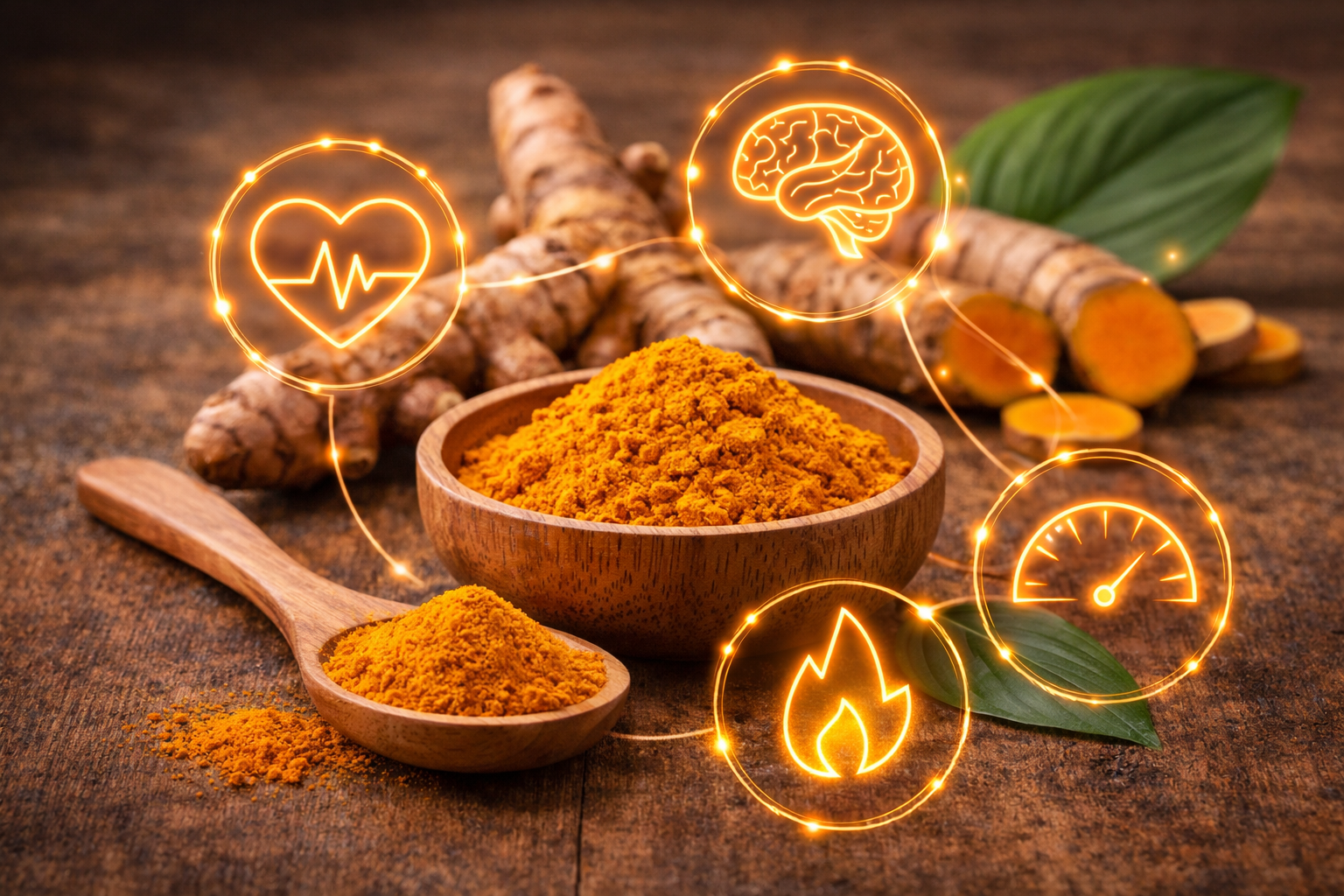
What Is Curcumin, Exactly?
Turmeric and curcumin are often used as if they mean the same thing, but they describe two different levels of the same plant. Turmeric is the whole spice — the dried, milled rhizome of Curcuma longa. Curcumin is one specific molecule found inside that rhizome, and it happens to be the one nutrition scientists have studied more than any other compound turmeric contains.
A simple way to picture the relationship: coffee beans contain caffeine, but "coffee" and "caffeine" are not interchangeable words — one is the whole food, the other is a single active constituent inside it, present in a percentage that varies from bean to bean. Turmeric and curcumin work the same way. Every turmeric rhizome contains curcumin, but not every rhizome contains the same amount of it.
Curcumin belongs to a small family of related pigment compounds called curcuminoids. Alongside curcumin, this family includes demethoxycurcumin and bisdemethoxycurcumin — two closely related molecules that occur naturally alongside curcumin in the rhizome, generally in smaller proportions. When a lab report states a "curcumin %" or "curcuminoid %," it is measuring this combined group of compounds, which is why the exact wording on a Certificate of Analysis matters.
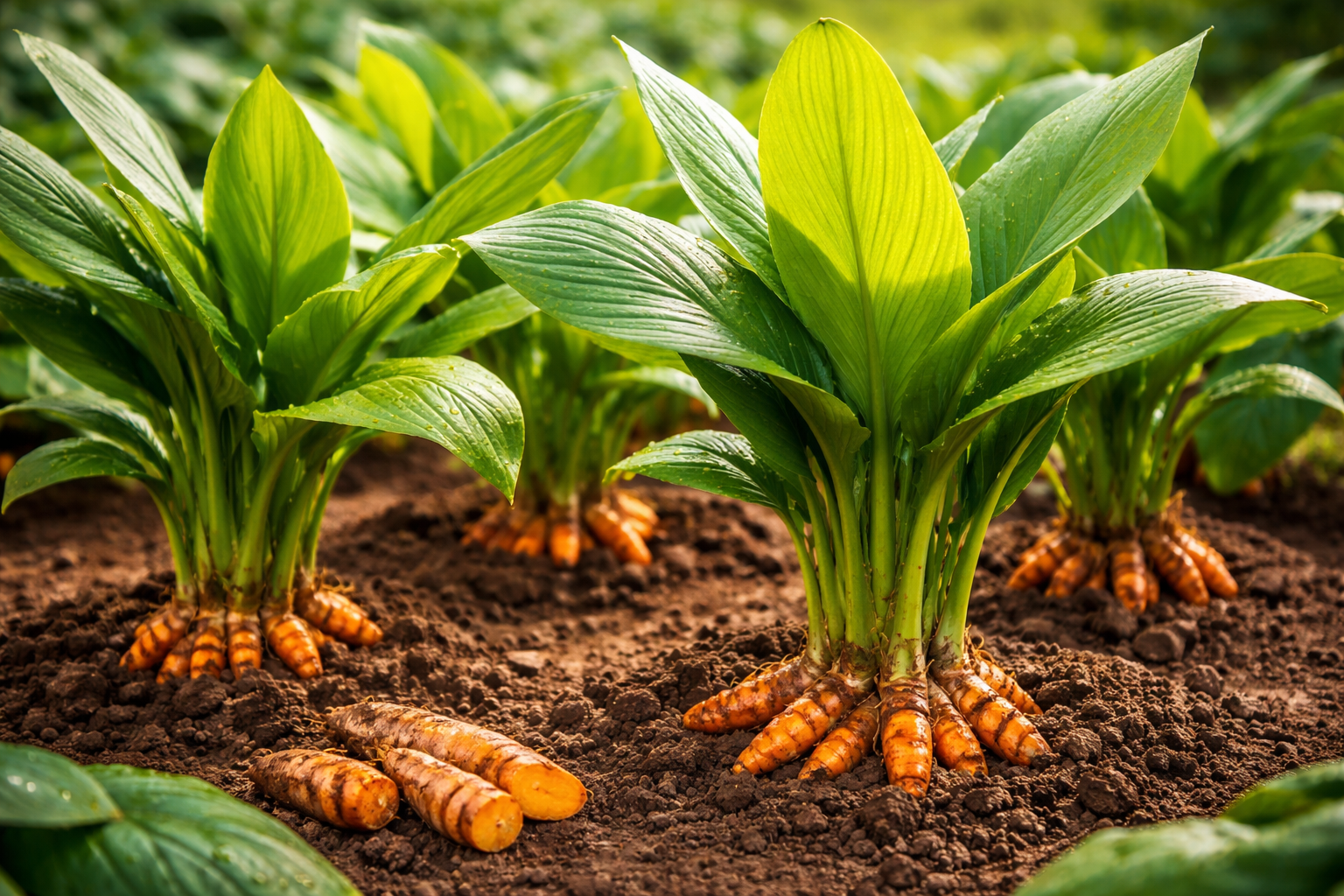
The deep orange interior of a freshly cut turmeric rhizome — a visual cue, though not a substitute for lab-verified curcumin content.
Buying "turmeric" tells you almost nothing about how much curcumin you're getting — that number depends entirely on the variety, the soil it grew in, and how carefully it was tested. Two jars labelled identically as "turmeric powder" can carry curcumin levels several times apart.
Turmeric vs Curcumin: Where Buyers Get Confused
Marketing copy on spice jars and supplement bottles frequently blurs the line between "turmeric" and "curcumin," and that blurring isn't accidental — curcumin sounds more clinical and sells better on a label. Understanding what each word actually refers to lets you read past the marketing and evaluate what you're really buying.
🌾 Turmeric (the whole spice)
- A dried, ground rhizome — a whole food, not an isolated compound
- Contains curcuminoids, natural oils, fibre, starch and trace minerals
- Used whole or powdered in cooking, golden milk, and traditional preparations
- Curcumin content typically ranges from roughly 2% to 12% of dry weight, depending on variety and origin
🧪 Curcumin (the compound)
- One of three curcuminoids naturally present in the turmeric rhizome
- The constituent behind turmeric's orange-yellow colour
- The single most-researched compound in turmeric
- Poorly water-soluble and rapidly broken down by the body when consumed alone
This distinction matters most at the point of purchase. A product labelled "turmeric" is not automatically a meaningful source of curcumin — the packaging is under no obligation to disclose curcuminoid percentage unless the supplier chooses to test and publish it. A genuinely useful label states a specific curcumin percentage, backed by a lab report, rather than the word "turmeric" alone.
Why Curcumin Content Varies So Widely by Variety
Curcumin percentage is not a fixed nutrition fact the way protein or fibre content might feel on a food label — it shifts meaningfully based on genetics, growing conditions, and how the crop is handled after harvest. Three factors drive most of that variation: the cultivar itself, the soil and altitude it was grown in, and the drying and curing process used before milling.
Grown widely across Tamil Nadu, Andhra Pradesh and Maharashtra for the mass culinary market. Reliable for everyday cooking, but curcuminoid content is comparatively modest.
~2–4% curcuminKnown in the spice trade for its deep colour and aroma, commonly used in export-grade curry powders and blends where visual richness matters.
~3.5–5% curcuminCultivated in the Jaintia Hills under GI Tag No. 741. The specific combination of altitude, laterite soil and rainfall in this region is associated with unusually high curcuminoid concentration.
~7–12% curcuminHigh-performance liquid chromatography (HPLC) is the gold-standard method for quantifying curcuminoid content precisely, and it's what accredited spice-testing laboratories generally use. UV-spectrophotometry is a faster, cheaper alternative that some sellers rely on instead — it can be less precise and is more prone to overstating results. When comparing suppliers, it's worth asking which method produced the number on their Certificate of Analysis.
What the Research Says About Curcumin
Curcumin is among the most extensively studied plant compounds in modern nutrition science, with a large and still-growing body of laboratory and clinical research examining how it behaves in the body. Interest tends to cluster around a handful of recurring themes in the literature:
- 🛡️Antioxidant activity — curcumin has been studied for its capacity to help neutralise free radicals in laboratory models.
- 🔥Inflammatory response — a substantial share of curcumin research investigates its interaction with inflammatory pathways in the body.
- 🦵Joint comfort and mobility — several clinical trials have examined curcumin supplementation in populations reporting joint discomfort.
- 🌿Digestive wellness — turmeric has a long history of traditional use in South and Southeast Asian food and folk medicine systems for supporting digestion.
- ✨Skin and complexion — turmeric paste has a long tradition of topical use in South Asian households and ceremonial practice.
This section summarises general areas of scientific interest and traditional use — it is not medical advice. Turmeric and curcumin products are not intended to diagnose, treat, cure, or prevent any disease, and none of the statements above have been evaluated by a national drug or health regulatory authority. Curcumin can interact with certain medications, including blood thinners, and may not be appropriate for people with gallbladder conditions. Please speak with a qualified healthcare professional before adding any new supplement to your routine, particularly if you are pregnant, nursing, taking medication, or managing a health condition.
Why Curcumin Alone Is Poorly Absorbed
A high curcumin percentage on a lab report is only half the story. Curcumin on its own has notably poor water solubility, and the liver metabolises it very quickly — meaning a meaningful share of an oral dose can pass through the digestive system largely unused unless it's paired with something that helps the body absorb and hold onto it.
- Black pepper (piperine) consumed alongside curcumin
- Cooking in a fat — ghee, coconut oil, or olive oil
- Gentle heat, which can help release curcuminoids from raw rhizome
- Finely milled or micronised powder with smaller particle size
- Liposomal or phospholipid-complex supplement formulations
- Curcumin taken alone in water, with no fat or pepper
- Extended exposure to light and humidity during storage
- Old stock that has passed its effective shelf life
- Low-curcumin base material diluted with fillers
- Prolonged high-heat cooking, which can degrade curcuminoids over time
A frequently cited pharmacokinetic study from the late 1990s found that combining curcumin with piperine produced a dramatic increase in blood curcumin levels compared with curcumin taken alone — a finding that has since become one of the most-referenced data points in curcumin research and a large part of why so many supplement formulas now include black pepper extract.
Source Curcumin-Rich Turmeric Direct From Meghalaya
GI-certified · 7–12% curcumin, lab-tested per batch · APEDA registered · Powder, whole finger & private label · Worldwide export
Turmeric Powder, Curcumin Extract, or Capsules?
There is no single "best" format — the right choice depends on whether you're cooking, building a supplement product, or simply looking for a consistent daily intake without measuring anything.
The rhizome itself, fresh or dried, used whole in cooking and traditional remedies. Delivers curcumin within its natural whole-food matrix alongside oils and fibre.
- Affordable and widely available
- Versatile across cooking and DIY use
- Whole-food nutrient matrix, not isolated
- Curcumin % varies significantly by source
- Harder to dose precisely
Milled from a documented high-curcumin variety such as Lakadong (7–12%), tested per batch. Works in the kitchen and for DIY golden milk while meaningfully raising curcuminoid intake per gram.
- Traceable origin and lab-tested batches available
- Whole-spice matrix, not an isolate
- Flexible — culinary and everyday wellness use
- Still benefits from pairing with fat and pepper
A concentrated extract standardized to around 95% curcuminoids, typically paired with piperine or a lipid carrier and encapsulated for precise, consistent daily dosing.
- Precise, repeatable dosing
- Often formulated specifically for absorption
- Convenient for daily supplement routines
- Isolated compound, removed from the whole-food matrix
- Generally higher cost per gram of curcumin
How to Verify a Curcumin Content Claim
A curcumin percentage printed on a product page or listing is a claim, not proof. Before trusting a stated figure — especially for supplement-grade or bulk purchases — check for the documentation behind it.
The gold-standard test for quantifying curcuminoid content precisely. Ask which method was used before accepting a stated percentage.
Ask For ThisThe Certificate of Analysis should reference the exact batch or harvest lot you're purchasing — not a generic report reused across seasons.
Ask For ThisRelevant specifically if a seller markets their product as Lakadong turmeric — the GI tag is the legal proof of Jaintia Hills origin.
If Claiming LakadongHigh moisture content dilutes effective curcuminoid concentration per gram — a complete COA reports this alongside the curcumin figure.
Good PracticeParticularly important for supplement-grade sourcing or export, where destination-country regulations may require residue testing.
Supplement-GradeCurcuminoids degrade gradually with age and poor storage. A dated, properly stored batch retains its tested potency far better than old stock.
Worth CheckingGetting More Curcumin Into Your Daily Routine
Commercial curcumin supplements commonly list daily curcuminoid intake somewhere in the range of 500 mg to 2,000 mg, usually paired with piperine or a lipid carrier — but the right figure varies by product, formulation, and the individual. Always follow the label directions on the specific product you're using, and consult a healthcare professional to determine what's appropriate for you.
FAQs — Turmeric Curcumin
Turmeric is the whole spice — the dried, ground rhizome of Curcuma longa, containing fibre, natural oils, starch and minerals. Curcumin is one specific compound found inside turmeric, part of a small group called curcuminoids, and it's the constituent most associated with turmeric's colour and with the majority of published research on the plant. Every turmeric contains curcumin; the amount just varies by variety.
It depends entirely on the curcumin percentage of the specific turmeric used. A teaspoon of standard commercial turmeric (around 2–4% curcumin) contains meaningfully less curcumin than the same teaspoon of a high-curcumin variety like Lakadong turmeric (7–12%). Because curcumin content isn't standardized across brands, the only reliable way to know is to check the batch's lab-tested percentage rather than assume based on the word "turmeric" alone.
Yes — this is one of the more well-established findings in curcumin research. Piperine, the compound responsible for black pepper's pungency, has been shown in pharmacokinetic studies to significantly increase how much curcumin reaches the bloodstream compared with curcumin consumed alone. This is why many curcumin supplements list piperine or "BioPerine" as an ingredient, and why traditional recipes pairing turmeric with black pepper turn out to have a scientific basis.
Lakadong turmeric, grown in the Jaintia Hills of Meghalaya and protected under Geographical Indication Tag No. 741, is documented by lab analysis at roughly 7–12% curcumin — among the highest verified levels of any turmeric variety worldwide. This is significantly above standard commercial turmeric (2–4%) and Alleppey turmeric from Kerala (3.5–5%). The elevated content is attributed to the region's specific soil chemistry, altitude, and rainfall pattern.
Neither is strictly "better" — they serve different purposes. A standardized extract (commonly 95% curcuminoids) offers precise, consistent dosing and is usually formulated with an absorption enhancer, making it well suited to supplement use. Whole high-curcumin turmeric powder delivers curcumin within its natural food matrix, works in everyday cooking, and retains the culinary and traditional-use qualities of the whole spice. Many households and brands use both, depending on the goal.
Ask for a batch-specific Certificate of Analysis from an accredited lab, ideally tested by HPLC rather than the less precise UV-spectrophotometry method. The COA should reference the exact lot you're purchasing, not a generic report reused across seasons. If the product is marketed as Lakadong turmeric specifically, also ask for GI Certificate No. 741 to confirm Jaintia Hills origin. A supplier confident in their claim will provide this documentation without hesitation.
Curcumin is generally recognised as safe within typical culinary use, but concentrated supplement doses are a different matter. Curcumin may interact with certain medications, including blood thinners, and may not be suitable for people with gallbladder conditions or those undergoing surgery. It is not a substitute for medical treatment. If you're pregnant, nursing, on medication, or managing a health condition, speak with a qualified healthcare professional before starting a curcumin supplement.
Choosing a Genuine High-Curcumin Turmeric
Curcumin is what turns "turmeric" from a vague spice-aisle word into a measurable, comparable ingredient. Once you understand that curcumin content varies by variety, that absorption depends heavily on what you pair it with, and that any stated percentage should be backed by a real lab report, sourcing decisions become much easier to make with confidence — whether you're stocking a kitchen, formulating a supplement, or buying in bulk for resale.
The short version: look past the word "turmeric" on its own, ask for the curcumin number, ask how it was tested, pair it with fat and black pepper for better absorption, and store it properly once you have it.
- 🧪Ask for the curcumin percentage — "turmeric" alone tells you nothing about curcuminoid content.
- 🔬Request a batch-specific HPLC report — generic or untested claims aren't verifiable.
- 🌶️Pair with black pepper and fat — absorption depends on more than just the percentage on the label.
- 🏅Check origin credentials — GI Tag No. 741 confirms genuine Jaintia Hills Lakadong turmeric.
- 📦Store it away from light and moisture — curcuminoids degrade gradually with poor storage.
- ⚕️Treat supplement dosing as a healthcare conversation — not a one-size-fits-all number.
GI-registered direct farm exporter · NABL-accredited COA per batch, curcumin 7–12% · APEDA certified · Powder, whole finger & private label supply · Organic and Halal certification available on request · Worldwide export to 50+ countries · Transparent USD pricing, no opaque brokered chains.