What Is a Lakadong Turmeric Manufacturer in Meghalaya?
The word "manufacturer" gets used loosely in the spice trade, and it matters more than most buyers realise. A Lakadong turmeric manufacturer in Meghalaya is an operation that physically processes raw turmeric rhizome — cleaning it, curing it, drying it, grinding it, testing it, and packing it — inside its own facility or a facility it directly controls. A trader, by contrast, buys finished turmeric from someone else and resells it under a label. Both may use the word "manufacturer" on a website.
This distinction sits on top of the legal one that governs the category: GI Tag No. 741, which restricts the Lakadong name to turmeric genuinely grown in East and West Jaintia Hills. A GI tag tells you where the rhizome came from. It does not tell you who processed it, how it was processed, or whether the batch you receive can be traced back to a specific harvest lot. That second layer of accountability is what a real manufacturing operation adds.
A trader can source Lakadong turmeric. Only a manufacturer can show you, batch by batch, what actually happened to it before it reached your order.
In practice, a functioning manufacturing setup includes direct procurement arrangements with Jaintia Hills farming cooperatives, an in-house or closely contracted processing line, batch-level quality testing, and finished-goods packaging carried out under a licence category meant for production — not resale.
India's FSSAI system issues separate licence categories for manufacturing and for trading or wholesale. A business can legally sell turmeric under a trading licence without operating a single piece of processing equipment. Before calling anyone a "manufacturer," ask to see which category their licence falls under — it is one of the fastest ways to separate an actual production unit from a repackaged trading business.
Why Manufacturing Is Anchored Inside the Jaintia Hills
Turmeric rhizome begins losing moisture and volatile oil the moment it is pulled from the ground. That is the practical reason processing in Meghalaya happens close to the field rather than after a long journey to a distant industrial hub — every extra day between harvest and curing is a day the curcumin-rich oil has a chance to degrade.
The Jaintia Hills sit at 800–1,200 metres, with acidic laterite soil, heavy monsoon rainfall, and cool growing-season temperatures. Spices Board and ICAR studies have linked this specific combination of altitude, rainfall, and soil chemistry to Lakadong's unusually high curcumin content — a result that has not been reproduced when the same seed stock is grown in other regions.
The fog-covered Jaintia Hills terrain — most primary processing happens within a short distance of the fields themselves.
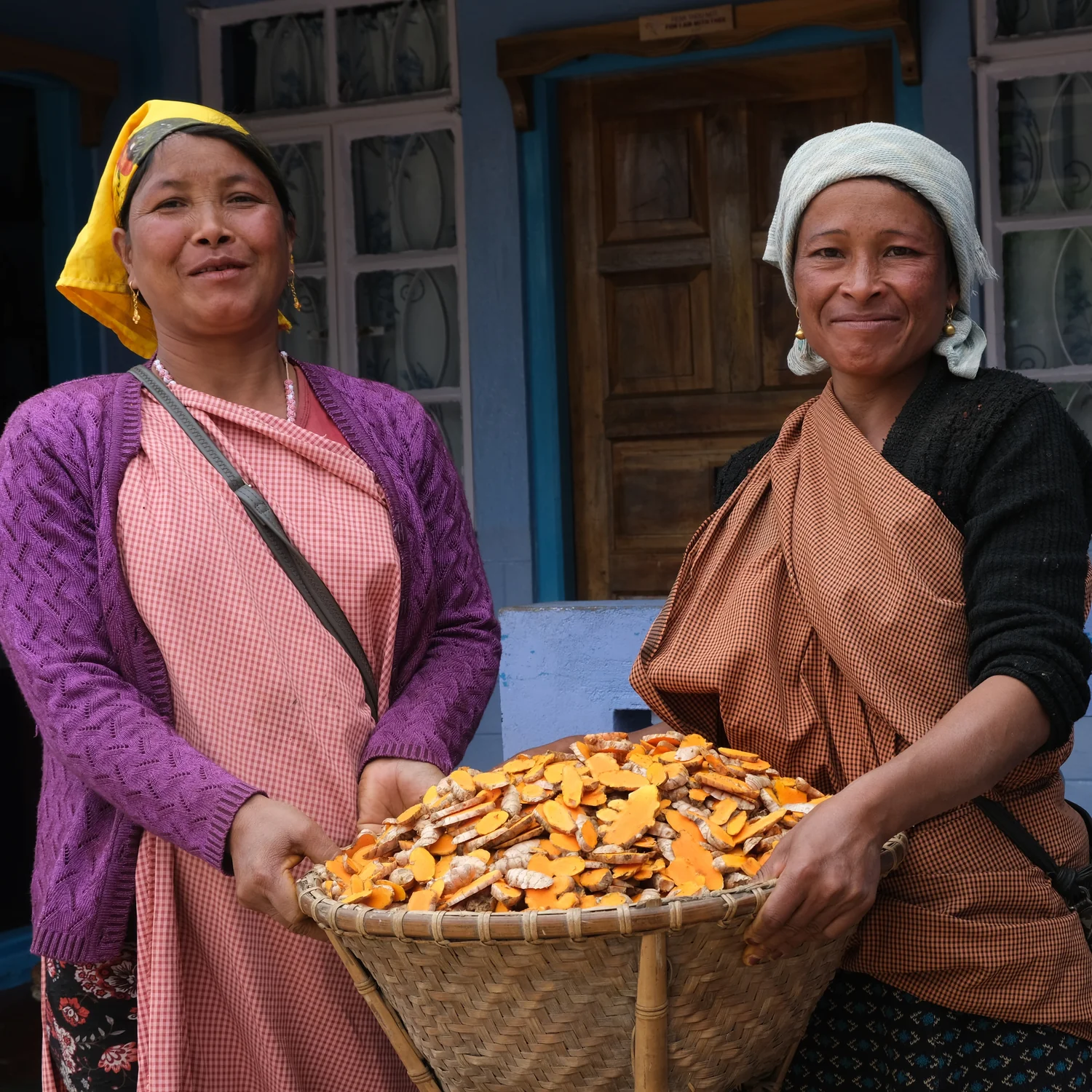
Because of this, Meghalaya's manufacturing structure is naturally two-tiered rather than built around one giant central factory. Village-level cooperatives handle the first stage — washing, boiling and drying — within hours of harvest, close to where over 13,000 tribal farming families cultivate the crop. The semi-processed, stabilised rhizome is then moved to larger grinding, testing and packaging units for the finishing stages. Understanding this structure explains why "manufacturer" can mean different things depending on which tier of the chain a business actually operates in.
Inside the Process: How Lakadong Turmeric Is Manufactured
A genuine manufacturing line follows a consistent sequence, whether it is run by a village cooperative or a larger integrated facility. Nine stages take raw rhizome to a sealed, batch-coded, retail-ready product.
Types of Lakadong Turmeric Manufacturing Units in Meghalaya
Not every operation calling itself a manufacturer sits at the same point in the chain. The table below reflects the four tiers most buyers will encounter when sourcing from Meghalaya.
| Unit Type | Scale & Equipment | Typical Documentation | Best Suited For |
|---|---|---|---|
| Village Cooperative Unit | Small-batch boiling and sun-drying, manual sorting and grading | Farm registers, GI-linked harvest records | Primary processing and raw material aggregation, not usually direct export |
| Mid-Scale Grinding & Packaging Unit | Mechanical dryers, hammer mills, moderate seasonal throughput | FSSAI manufacturing licence, batch COA | Regional distributors and domestic brand buyers |
| Integrated GI-Registered Plant | Full line under one roof — cleaning through packaging — with HACCP/ISO systems | GI 741, FSSAI, APEDA, NABL COA, phytosanitary certificate | International buyers, food and supplement manufacturers, private label brands |
| Contract / OEM Manufacturer | Production runs to buyer specification — grind size, blend, packaging format | Transferable COA and GI documentation issued under the buyer's brand | Brands wanting a finished, shelf-ready private label product |
Certifications Every Manufacturing Unit Should Hold
Documentation is how a manufacturing claim gets verified. These are the certifications a genuine, export-ready Lakadong turmeric manufacturer in Meghalaya should be able to produce without hesitation.
Inside the Quality Control Lab
A production line is only as trustworthy as the testing that gates it. Reputable manufacturing units test a sample from every batch before it is cleared for packaging — this is what prevents ordinary commodity turmeric from ever reaching a customer under the Lakadong name.
📑 Typical Batch Release Parameters
Tested Per BatchAsk any manufacturer for the Certificate of Analysis tied specifically to the batch you are being offered — not a generic report from a different production run. A batch number that does not match your intended shipment is a signal to keep looking, regardless of how complete the rest of the paperwork appears.
Private Label & Contract Manufacturing in Meghalaya
Integrated manufacturing units increasingly offer contract production for brands that want a finished, shelf-ready product rather than raw bulk powder. This typically covers four areas:
📦 Custom Packaging Formats
Stand-up pouches, glass jars, kraft paper bags, or bulk drums — filled and sealed to the buyer's specification.
⚙️ Formulation Flexibility
Fine culinary powder, coarser grind, or micronized powder suited to capsule filling and supplement use.
📄 Documentation Transfer
Batch COA and GI reference issued so the buyer's own brand can present compliant sourcing documentation to retailers.
🗓️ Dedicated Production Runs
Runs scheduled against the buyer's own calendar rather than filled from shared, undifferentiated stock.
Lead times for first private label runs are generally longer than for standard bulk orders, largely because export documentation has to be reissued under the buyer's entity — factor this into any launch timeline rather than assuming it moves at the same pace as a straightforward wholesale order.
Five Questions to Ask Before You Commit
A short conversation, asked in the right order, tells you more than most brochures. These five questions are enough to separate an operating manufacturer from a business that only sounds like one.
FAQs — Lakadong Turmeric Manufacturers in Meghalaya
A Lakadong turmeric manufacturer is a registered processing operation in the Jaintia Hills region that physically converts raw, GI-tagged turmeric rhizome into finished powder or graded fingers — covering cleaning, curing, drying, grinding, testing and packaging — rather than simply reselling turmeric sourced from a third party.
Production runs through nine stages: harvesting and sorting, washing, boiling or curing, controlled drying, polishing, grinding and micronizing, sieving and grading, batch quality testing, and finally packaging under a traceable batch code. Each stage happens in sequence, and a batch is not released for sale until testing at the eighth stage confirms it meets specification.
A credible manufacturing unit holds GI Certificate No. 741, an FSSAI manufacturing licence, APEDA registration for export, HACCP or ISO 22000 food safety certification, and NABL-accredited lab reports for each production batch. Export-bound units additionally need a phytosanitary certificate and an IEC code.
A manufacturer operates or directly controls the processing line and can produce batch-level production records tied to a specific harvest lot. A supplier may aggregate and resell turmeric already processed by someone else, which can mean less visibility into how the product was actually handled before it reached them.
Established, integrated manufacturing units generally do. This includes custom grind size, a choice of packaging formats such as pouches, jars and kraft bags, and documentation reissued under the buyer's own brand name to support retail compliance in the destination market.
Cross-check the GI certificate and APEDA registration, request a batch-specific COA rather than a generic lab report, ask which FSSAI licence category applies, and — for larger commitments — arrange a facility visit during the January–February harvest window when production is active and easiest to observe firsthand.
Choosing a Manufacturer You Can Build a Supply Chain On
Global demand for high-curcumin turmeric keeps rising, and Meghalaya's Lakadong variety remains the benchmark. But the word "manufacturer" only means something when it is backed by a facility you can point to, a licence category built for production, and a batch of paperwork that matches the exact lot on offer — not a set of claims repeated across a website.
Work With the Processing Unit, Not a Reseller
GI-registered manufacturing · FSSAI production licence · NABL-tested batches · HACCP-aligned facility · Private label & OEM capability · Worldwide export documentation