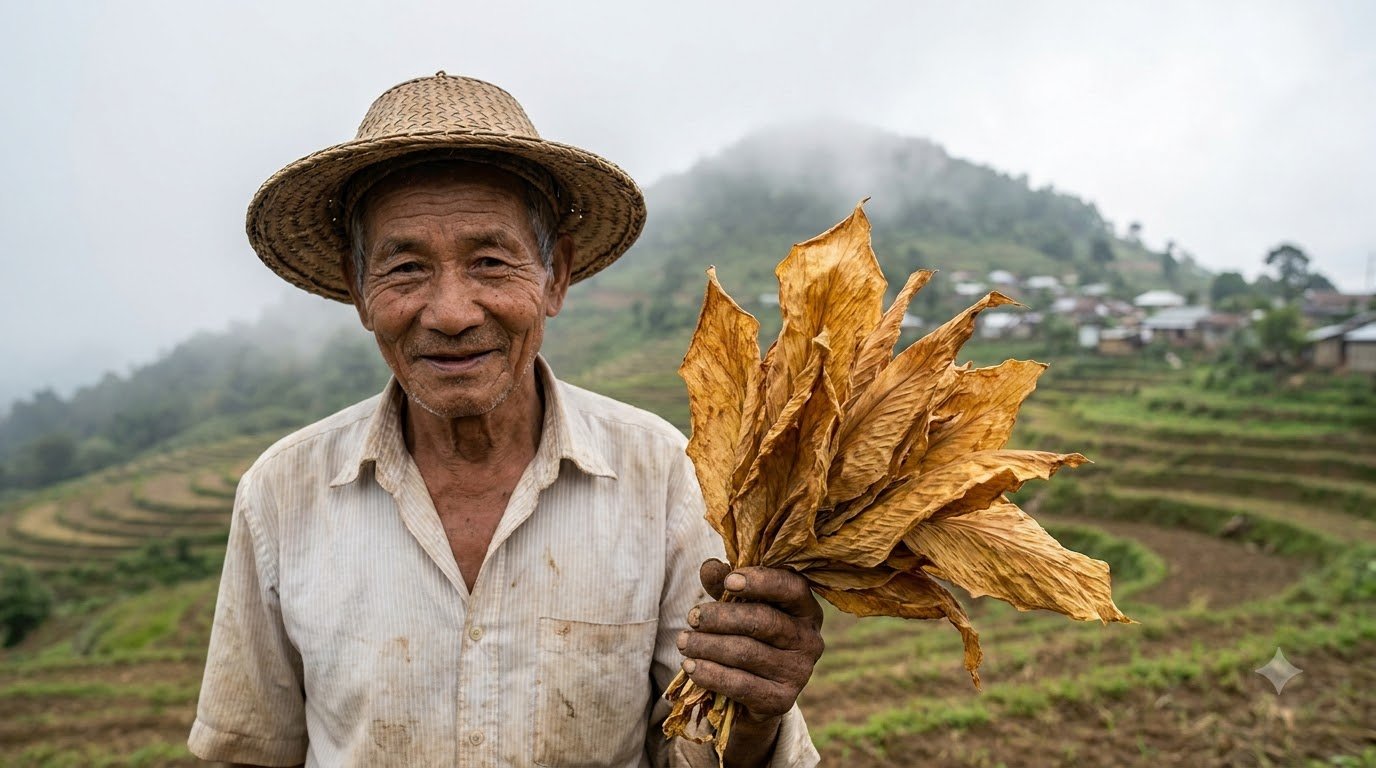
What Actually Makes Dried Turmeric Leaves the Best in the World?
Search for "best turmeric leaves in the world" and, unlike turmeric powder, you'll find surprisingly little written about it. Turmeric leaf is a far more regional, specialty ingredient, and there's no spice-trade body handing out a global grading system for it. What actually separates a genuinely good batch of dried turmeric leaves from an average one comes down to a shorter, more practical checklist: how mature the leaf was at harvest, how it was dried, whether it survived that process whole, how it smells once the pack is opened, and whether the seller can say where it was actually grown.
It helps to be clear about what turmeric leaf is not. Unlike the rhizome — the part ground into the bright yellow powder most people know — the leaf carries only negligible curcumin. Its value is almost entirely aromatic: a floral, gingery, citrus-leaning fragrance that shows up in a dish as a background note rather than a colour. That's an important distinction, because most "best turmeric" content online is really about curcumin percentage in the root, and none of that transfers directly to leaf quality.
This guide is focused specifically on dried turmeric leaves: what separates a fragrant, whole, well-dried batch from a dusty, flat one, where in the world the leaf actually shows up in cooking, and how to tell a genuine, traceable batch from a vague "imported turmeric leaf" bag with no real story behind it.
Instead of asking "which turmeric leaf is the best in the world," it's more useful to ask: "was this leaf harvested young, dried gently, kept whole, and can the seller tell me where it grew?" A batch that answers yes to all four is a genuinely strong candidate — regardless of how it's marketed.
Where the World's Most Fragrant Turmeric Leaves Are Grown
Because dried turmeric leaves carry negligible curcumin, the figure that actually matters for quality isn't a lab percentage the way it is for the root — it's aroma retention. The comparison below is an orientation guide based on how turmeric leaf is traditionally grown, harvested and dried across regions with a long culinary relationship with the leaf. It isn't a laboratory measurement, and any real batch should still be judged on its own smell and paperwork.
World Aroma & Freshness Index, By Growing Region
An illustrative comparison of typical aroma retention in dried turmeric leaf, based on regional harvesting and drying traditions — for orientation only.
How Buyers Judge a Dried Turmeric Leaf Batch
There's no single spec sheet for turmeric leaf the way there is for graded spices. In practice, experienced buyers work through a short, repeatable checklist instead.
A Five-Point Quality Meter for World-Class Turmeric Leaves
Rather than a single number, a fuller picture of leaf quality comes from looking at five dimensions together. The meters below illustrate what a young-harvest, gently dried, whole-leaf batch tends to look like against this framework — an illustrative benchmark, not an official rating system.
Illustrative Quality Meter — Top-Tier Benchmark
Each meter shows a representative score out of 100 for a young-harvest, shade-dried, whole-leaf batch with traceable origin.
How much of the leaf's natural fragrance survives the drying process.
Whether the leaf keeps a natural, even green rather than fading or browning.
The proportion of leaves that stay intact rather than shattering into fragments.
How consistently dry the batch is, which determines mould risk during storage.
Whether the batch can be tied to a specific growing region or cooperative.
Where Dried Turmeric Leaves Are Actually Used
India's coastal and hill-belt regions carry the deepest culinary relationship with turmeric leaf. In the Northeast, across Meghalaya's Jaintia Hills and neighbouring Assam, turmeric has long been grown as a household crop, with both the rhizome and the leaf finding their way into local kitchens. Along the Konkan coast and in Goa, fresh and dried leaves flavour curries and are wrapped around rice-based sweets for steaming. Karnataka's Mangalore-Udupi belt is particularly known for patholi and kadubu — rice-flour dumplings steamed inside a folded turmeric leaf, closely tied to regional festivals.
Outside India, turmeric leaf shows up across island and mainland Southeast Asia. In Indonesia, particularly Aceh and parts of Sumatra, the leaf is a defining ingredient in slow-cooked, coconut-based dishes. Malaysia and Singapore lean on it heavily in rendang, where a torn or bruised leaf is simmered into the gravy for fragrance rather than added for colour. Thailand uses it more selectively, mostly in regional curries where a citrus-forward top note is wanted alongside lemongrass and galangal.
What's consistent across every one of these traditions is that turmeric leaf is used sparingly and specifically — for fragrance, not bulk — almost always alongside other aromatics like lemongrass, tamarind, coconut or ginger, rather than as a standalone seasoning the way turmeric powder often is.
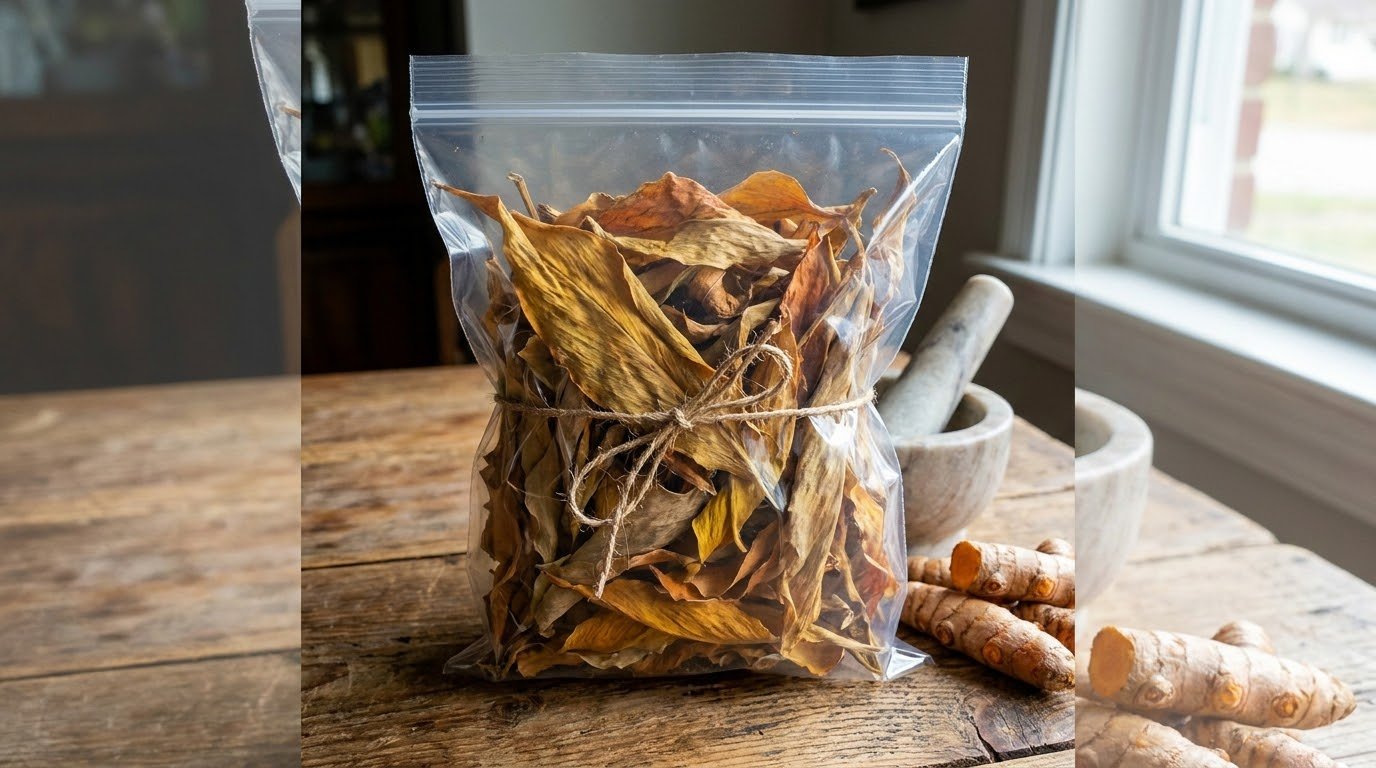
Young, tender leaves picked before flowering are generally prized for a cleaner, more concentrated aroma once dried.
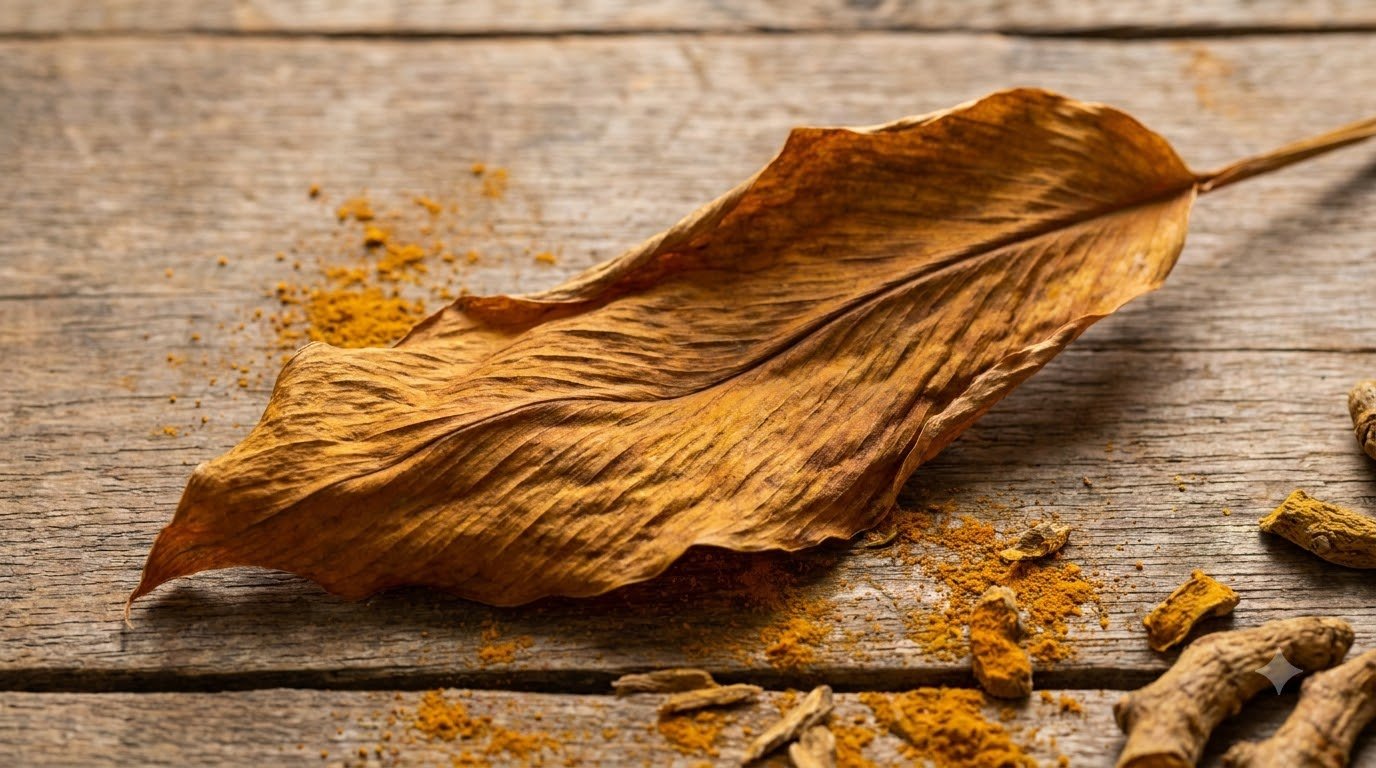
Whole, unbroken leaves like these usually indicate a gentler drying process rather than a rushed, high-heat one.
Fresh, Shade-Dried, Sun-Dried or Machine-Dried — What Actually Holds Aroma?
How a turmeric leaf is dried affects its final quality more than almost any other single factor, because its aroma lives in volatile oils that break down under heat and direct light. Here's how the four most common approaches compare.
Processing Method Comparison
How each drying approach typically affects aroma, colour and shelf life. Ratings are illustrative and can vary by producer and equipment.
Fresh-Cut
Strongest aroma of all, but keeps for about a week refrigerated — not a stored, tradeable product.
Shade-Dried
Best for AromaSlow drying out of direct sun — the gentler method favoured for whole-leaf, export-grade batches.
Sun-Dried
Fast and low-cost, but direct heat and light tend to bleach colour and drive off fragrance.
Machine / Low-Temp Dried
Controlled, low-temperature drying can rival shade-drying at larger commercial volumes when done carefully.
Turmeric Leaf vs Curry Leaf — Not the Same Ingredient
One of the most frequent mix-ups in spice shopping is assuming "turmeric leaf" and "curry leaf" are interchangeable, or even the same thing sold under two names. They're not — different plant, different flavour, different job in the kitchen.
Two Leaves, Two Plants, Two Jobs
A side-by-side look at what actually separates them.
Turmeric Leaf
- From Curcuma longa — the turmeric plant itself
- Long, lance-shaped single leaf, roughly 15–20cm
- Floral, gingery, citrus-leaning aroma
- Used whole — for wrapping, steaming or simmering
- Carries only negligible curcumin
Curry Leaf
- From Murraya koenigii — an entirely different tree
- Small, oval leaflets growing in a pinnate cluster
- Nutty, citrusy, slightly bitter aroma
- Used for tempering (tadka) in hot oil or ghee
- Botanically unrelated to turmeric
Why Purity & Handling Matter More Than Any Label
Dried turmeric leaf doesn't carry the same widely publicised adulteration reputation that turmeric powder does, but it has its own, quieter quality problems. Because whole leaves are harder to grade visually than powder, lower-quality bundles are sometimes padded out with older, coarser leaves, off-season stock, or — occasionally — leaves from an entirely different plant, especially in loosely labelled bulk bags sold without any origin claim.
The bigger risk, though, is simply poor handling. Leaves dried too fast in direct sun lose much of their fragrance and colour before they even reach a warehouse, and leaves packed away before they're fully dry are prone to developing mould during storage or shipping — a musty smell is usually the first sign, well before any visible spotting.
If a "best turmeric leaves" claim rests only on a product photo, that's worth a second look. A genuine batch should smell distinctly aromatic and clean straight out of the bag — never flat, dusty or musty — and the seller should be able to say plainly how and where the leaves were dried.
Curious What a Genuinely Well-Dried Batch Smells Like?
We source turmeric leaf from the same Jaintia Hills growing belt behind our GI-registered lakadong turmeric — happy to talk through harvest timing, drying method and batch details on request.
How Dried Turmeric Leaves Actually Get Used
Part of what makes turmeric leaf worth understanding is how differently it's used from one kitchen tradition to the next — always for fragrance, rarely for bulk.
Used across South and Southeast Asia as a natural wrapper for fish and rice dumplings, infusing the dish with fragrance as it steams.
Along the Konkan coast, Goa and Karnataka, leaves flavour curries and the well-known patholi and kadubu dumplings made for regional festivals.
Malaysia, Singapore and Indonesia lean on turmeric leaf in rendang and gulai, usually torn or bruised to release its fragrance into the gravy.
Beyond the cooking pot, dried leaves are steeped for fragrant infusions and used in natural potpourri for their long-lasting scent.
A Practical Checklist for Choosing Dried Turmeric Leaves
Whatever country you're buying from, the same short checklist works everywhere.
- Leaves are whole, unbroken and uniformly coloured rather than shattered fragments
- A clear harvest or packing date is shown on the bag
- Origin is named — a specific growing belt or cooperative, not just "imported"
- The leaf smells distinctly aromatic and clean, not musty or flat
- Seller can explain how the leaves were dried — shade, sun or machine
- Stored and shipped in a sealed, moisture-proof pack
- Leaves are mostly crushed, dusty fragments rather than intact pieces
- No harvest date or origin information anywhere on the pack
- Musty, damp or "off" smell — a possible sign of mould during drying or storage
- Colour is unnaturally uniform bright green, hinting at added dye
- Bundle mixed with visibly different leaf types or foreign matter
- Seller has no answer when asked how or where the leaves were dried
- 👃Smell it before you commit — genuine dried turmeric leaf has a clean, gingery-citrus fragrance; anything musty is a red flag.
- 🍃Favour whole leaves — intact leaves hold their aroma far longer than pre-broken or powdered leaf.
- 📍Ask where it was grown — a named region beats a generic "imported" claim every time.
- ☀️Ask how it was dried — shade-dried or low-heat dried leaf usually outperforms fast sun-dried leaf on aroma.
- 🫙Store it properly — airtight, dark and dry storage is what actually determines how long the aroma lasts.
Get Details on Our Latest Turmeric Leaf Batch
Want to know the harvest window, drying method and origin behind a batch before you commit to anything, anywhere? We're happy to walk you through it.
FAQs — Dried Turmeric Leaves
Dried turmeric leaves are prized mainly for their aroma rather than colour or heat. Cooks use them to line steamers, wrap fish and rice dumplings, and season curries and slow-cooked dishes across South and Southeast Asia. Once dried and stored airtight, they keep their fragrance for months and are typically softened in water briefly before use.
No official global body ranks turmeric leaves the way some certifications exist for other commodities. In practice, quality is judged on a handful of measurable factors: leaf maturity at harvest, the drying method used, aroma retention, whole-leaf integrity, and moisture control, rather than a single agreed "best" label.
No — this is one of the most common mix-ups in the spice world. Turmeric leaves come from Curcuma longa, the same plant that produces the turmeric rhizome, while curry leaves come from an entirely different tree, Murraya koenigii. They look different, taste different and are used differently in cooking.
Only in negligible amounts. Curcumin, the compound most associated with turmeric root, is concentrated almost entirely in the rhizome, not the leaf. Turmeric leaves are valued instead for their aromatic oils, which carry a floral, citrusy, gingery fragrance that turmeric powder alone does not have.
Shade-drying removes moisture slowly out of direct sunlight, which generally helps the leaf hold on to more of its aroma and colour. Direct sun-drying is faster but tends to bleach the leaf and drive off more of the volatile oils that give turmeric leaves their fragrance, which is why quality-focused suppliers often favour shade-drying or low-temperature drying instead.
Kept in a sealed, airtight container away from light, heat and moisture, whole dried turmeric leaves can hold their aroma for several months. Crushing or grinding them ahead of time speeds up flavour loss, so it's best to keep leaves whole and break them only just before cooking.
Coastal and hill-belt regions of India, including Meghalaya and Assam in the Northeast, the Konkan coast, Goa and Kerala, have long traditions of cooking with turmeric leaves, alongside Karnataka's Mangalore-Udupi belt. Beyond India, Indonesia, Malaysia, Singapore and Thailand all use turmeric leaves in regional dishes, each favouring the leaf for a slightly different culinary purpose.
So, What Are the Best Turmeric Leaves in the World?
Answered honestly, there's no single "best turmeric leaf in the world" sitting on a shelf with a certificate to prove it. What exists instead is a short, checkable list: leaves harvested young, dried gently rather than rushed in direct sun, kept whole rather than crushed, and tied to a growing region someone can actually name. Batches that check all four boxes are a genuinely strong candidate, wherever in the world they were grown.
If you're comparing turmeric leaf for cooking, retail or bulk sourcing, the same approach works everywhere: smell it before you trust the label, ask how it was dried, and treat a vague "imported turmeric leaf" claim the same way you'd treat any other unverifiable claim — with a healthy amount of scepticism until someone can actually back it up.
- 👃Smell it first — clean and aromatic, never musty or flat.
- 🍃Choose whole leaves — intact leaf holds fragrance far longer than broken or powdered leaf.
- ☀️Ask about the drying method — shade-dried or low-heat dried leaf usually beats fast sun-dried leaf on aroma.
- 📍Confirm the origin — a named growing belt, not just a country.
- 🫙Store it properly — sealed, dark and dry is what actually protects the aroma over time.
We work directly with farming cooperatives across the Jaintia Hills belt in Meghalaya — the same region behind our GI-registered lakadong turmeric — to bring shade-dried, whole dried turmeric leaves to market alongside our turmeric rhizome and powder. Reach out through the form above for retail, bulk or export enquiries.