What Actually Makes a Turmeric the Best in the World?
Search for "best turmeric in world" and you'll find dozens of confident answers, and almost none of them agree with each other. That's because no single certifying body hands out a global award for turmeric. What food scientists, spice traders and serious home cooks actually mean when they reach for that phrase usually comes down to five things that can be measured, not just claimed: curcumin content, purity, a traceable growing origin, independent lab verification, and freshness at the time of purchase.
Curcumin does most of the heavy lifting in that list. It's the compound responsible for turmeric's colour and much of its flavour intensity, and it varies enormously depending on where and how the plant is grown — from as low as 1% in some bulk commercial turmeric up to the 7–12% range found in a handful of documented high-curcumin varieties. But curcumin alone doesn't settle the argument, because a turmeric can test high in curcumin and still be a poor buy if it's mixed with fillers, coloured artificially, or sold with no way to verify any of it.
That's really the point of this guide: not to crown one single "best turmeric in the world," but to lay out the actual criteria worth checking, show how curcumin content compares across major growing regions, and explain why a lab report will always tell you more than a label ever will.
Instead of asking "which turmeric is the best in the world," it's more useful to ask "can this specific batch prove its curcumin content, its origin, and its purity?" Turmeric that can answer all three is a genuinely strong candidate — regardless of how it's marketed. Turmeric that can't answer any of them isn't disqualified automatically, but it hasn't earned the claim either.
Where the World's Highest-Curcumin Turmeric Is Grown
Curcumin percentage is the single most-cited number when people argue about the best turmeric in the world, so it's worth seeing how growing regions actually stack up. The list below reflects typical mid-range figures reported across spice-trade literature and lab studies, not a single definitive lab result — every real batch should still be confirmed on its own Certificate of Analysis.
World Curcumin Leaderboard, By Growing Region
Approximate curcumin percentage, dry-weight basis, for well-documented growing regions and varieties.
How Buyers Actually Judge a "Best Turmeric" Claim
Serious spice buyers rarely take a "best in the world" label at face value. In practice, the judgement usually comes down to a short, repeatable checklist.
Where the World's Best Turmeric Actually Comes From
India is widely regarded as the world's leading turmeric producer, both in the sheer volume grown and in the sheer variety of cultivars under one flag. Within India alone, the profile changes dramatically by region: Meghalaya's Jaintia Hills produce the lakadong variety prized for its curcumin content; Kerala's Alleppey turmeric is known for its rich colour; Tamil Nadu's Erode and Salem belts and Telangana's Nizamabad market handle much of the country's bulk commercial trade; and Maharashtra's Sangli region supplies a large share of turmeric used in everyday Indian cooking.
Beyond India, turmeric is grown commercially across a surprisingly wide belt of the world. Indonesia and Bangladesh are major Asian growers with their own regional varieties. Peru, Jamaica and parts of the wider Caribbean grow turmeric that has found a strong following in wellness and natural-colourant markets. Nigeria and other West African countries are increasingly significant producers, and China, Myanmar and Sri Lanka round out a substantial share of global supply. Fiji and small-island Pacific growers, meanwhile, have built a reputation for aromatic, high-oil turmeric popular in natural cosmetics.
What ties all of this together is that "best turmeric in the world" isn't really a single-country story. It's a story about specific microclimates, specific soil chemistry, and specific farming traditions — the same reason a coffee bean or an olive can taste completely different depending on which valley it was grown in.
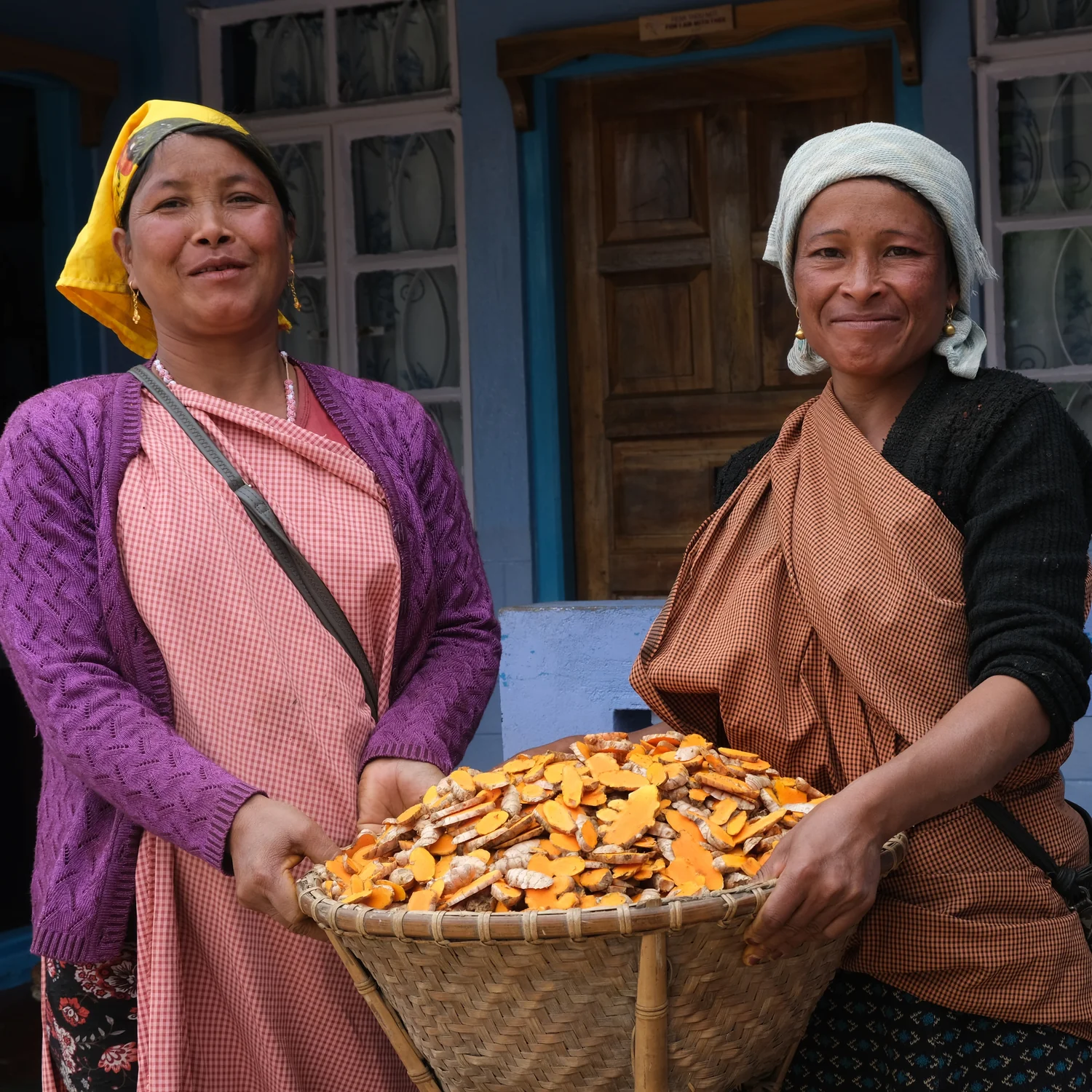
Cool, high-rainfall hill terrain like this is repeatedly linked to unusually high curcumin readings in the turmeric grown there.
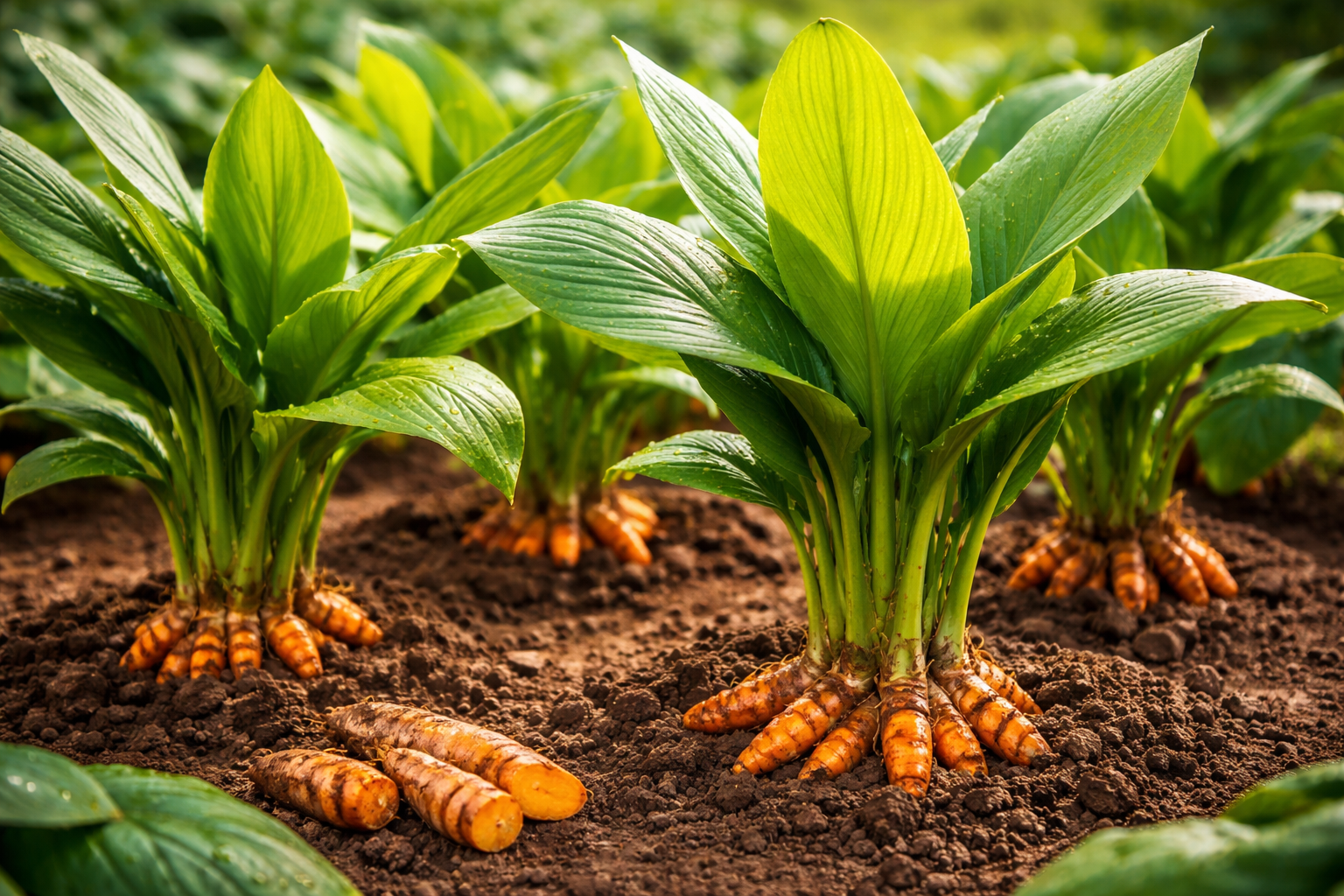
Freshly dug rhizomes. The intensity of the orange flesh is a rough field indicator, though it's never a substitute for an actual lab test.
A Four-Point Scorecard for World-Class Turmeric
Rather than a single curcumin number, a more complete way to judge a "best turmeric in the world" claim is across four dimensions at once. The scorecard below illustrates what a genuinely top-tier, fully lab-verified, GI-tagged batch tends to look like against this framework — it's an illustrative model for comparison, not an official industry rating system.
Illustrative Quality Scorecard — Top-Tier Benchmark
Each ring shows a representative score out of 100 for a well-documented, high-curcumin, GI-certified batch.
Why Purity Testing Matters More Than Any Label
Turmeric has a well-documented adulteration problem in parts of the global supply chain. Because buyers associate a deeper, brighter colour with higher quality, some lower-cost turmeric has historically been bulked out with starch, chalk or other root powders, or brightened using unauthorised colourants to fake the appearance of a high-curcumin batch. Food safety researchers and health authorities in several markets have flagged this as a genuine concern over the years, particularly around colourants that can pose health risks with repeated exposure.
This is exactly why colour and aroma, while useful, should never be the final word on quality. A powder can look impressively deep and still fail a lab test for curcumin, or worse, contain contaminants that a home cook or even an experienced buyer has no way of detecting by sight or smell alone.
If a seller's entire case for "best turmeric in the world" rests on how the powder looks in a photo, that's a signal to ask more questions — specifically for a batch-specific Certificate of Analysis and, ideally, a heavy-metal screening result. Genuine quality is provable; appearance alone is not.
Certifications Recognised Around the World
Different markets rely on different paperwork, but a handful of certifications turn up again and again wherever genuinely high-quality turmeric is sold internationally.
Global Certification Reference Table
What each document actually confirms, and where it typically carries the most weight.
| Certification | What It Confirms | Most Relevant Markets |
|---|---|---|
| Geographical Indication (GI) | Verified regional origin, tied to a specific place | India & other GI-registering countries |
| Accredited Certificate of Analysis | Curcumin, moisture, ash & volatile oil for that exact batch | Global — the single most important document |
| Heavy-Metal Screening Report | Absence of lead, arsenic or other contamination | Global, especially for export shipments |
| USDA NOP / EU Organic / NPOP | Certified organic growing & handling practices | United States, European Union, India |
| ISO 22000 / HACCP | Food-safety-managed processing & packing | Global export supply chains |
| Local Food Safety Registration | Domestic food safety compliance (e.g. FSSAI in India) | Country of origin |
Curious What a Genuinely Top-Tier Batch Looks Like?
We work directly with Jaintia Hills cooperatives to bring GI-certified, lab-verified lakadong turmeric to buyers worldwide — happy to share sample reports on request.
How the World's Best Turmeric Actually Gets Used
Part of what makes turmeric worth arguing about globally is how differently it's used from one kitchen tradition to the next.
The base note in most Indian, Sri Lankan and Bangladeshi curries and dals, where a small quantity carries both colour and earthy flavour.
Used to colour and flavour dishes like turmeric rice and regional curry pastes across Indonesia, Malaysia and Thailand.
A key ingredient in Caribbean curry powders and stews, often paired with allspice and scotch bonnet for a distinct regional profile.
Golden lattes, turmeric shots and smoothies have carried turmeric well beyond its traditional cooking use into everyday wellness routines worldwide.
A Practical Checklist for Choosing the Best Turmeric Powder
Whatever country you're buying from, the same short checklist works everywhere.
- A batch-specific Certificate of Analysis is available on request
- Origin is named specifically — a region, farm or cooperative, not just a country
- Powder is a deep, saturated orange rather than pale or dull yellow
- Packaging lists a harvest or batch date
- Seller is open to independent verification or third-party testing
- Any "best in the world" claim is backed by a lab number, not just adjectives
- No lab report offered, or testing described only as "in-house"
- Origin described vaguely, with no traceable region or farm
- Unusually bright or artificial-looking colour with no explanation
- No batch number or harvest date anywhere on the packaging
- "Organic" or "best in the world" claimed with no certificate to show
- Seller becomes vague or defensive when asked for documentation
- 🔬Start with the Certificate of Analysis — it's the single document that actually proves curcumin, moisture and ash content.
- 🧪Ask about heavy-metal testing — especially important for turmeric sourced from lower-cost or unfamiliar supply chains.
- 📍Check the origin claim — a named region or GI tag is worth far more than "imported" or "premium" on its own.
- 🎨Use colour as a clue, not proof — genuine high-curcumin turmeric looks deep and saturated, but that alone can be imitated.
- 🫙Buy only what you'll use in a reasonable time — even the best turmeric in the world slowly loses aroma once ground and exposed to air.
Get Our Latest Batch Certificate of Analysis
Want to see exactly what a genuinely lab-verified, GI-certified turmeric report looks like before you buy anything, anywhere? We're happy to share one.
FAQs — Best Turmeric in the World
No single country holds an official title, but India is generally regarded as the world's leading turmeric producer in both volume and variety, growing everything from ordinary bulk turmeric to exceptionally high-curcumin types such as Meghalaya's GI-tagged lakadong turmeric. Countries including Indonesia, Bangladesh, Peru and parts of the Caribbean also grow turmeric that performs well on specific measures like aroma or oil content, so "best" often depends on which quality metric matters most to the buyer.
Among commercially documented varieties, lakadong turmeric from the Jaintia Hills of Meghalaya is one of the highest-curcumin turmerics reported anywhere, with lab-tested batches commonly falling between 7% and 12% by dry weight. That's roughly two to four times the curcumin level found in most ordinary turmeric powder sold globally, which typically ranges from 1% to 3%.
Indian turmeric is widely respected globally because the country's growing conditions, decades of cultivar development and export infrastructure support everything from bulk commodity turmeric to boutique, high-curcumin, GI-protected varieties. Whether a specific batch is genuinely "the best" depends on the variety and the lab report behind it, not the country name alone.
Ask for the batch's Certificate of Analysis confirming curcumin, moisture and ash content from an accredited lab, and check whether the origin claim is backed by a Geographical Indication tag or other traceable sourcing document. Marketing language alone proves nothing without a lab report and verifiable origin behind it.
Colour is a useful early clue, since genuinely high-curcumin turmeric tends to look noticeably deeper and more saturated, but it is not proof on its own. Some adulterated turmeric has historically been artificially coloured to mimic a high-curcumin appearance, which is why colour should be treated as supporting evidence rather than a substitute for lab testing.
Yes, turmeric is one of the more commonly adulterated spices worldwide, sometimes bulked out with starch, chalk or other root powders, or artificially brightened with unauthorised colourants. Adulteration is typically caught through laboratory testing for curcumin content, ash and moisture levels, and screening for heavy metals or foreign starches.
At minimum, look for a batch-specific Certificate of Analysis from an accredited lab, verifiable origin proof such as a Geographical Indication tag or clear traceability to a named farm or cooperative, and relevant food-safety registration such as FSSAI, ISO 22000 or an equivalent local authority, plus export registration if the batch is sold internationally.
So, What Is the Best Turmeric in the World?
Honestly answered, the best turmeric in the world isn't a single named product — it's whichever batch can actually prove its curcumin content, its origin and its purity, rather than simply claiming them. On the evidence available, high-curcumin, GI-protected varieties like lakadong turmeric from the Jaintia Hills sit near the top of that list, but the same standard applies everywhere: a strong claim only means something when there's a lab report behind it.
If you're comparing options — whether for home cooking, retail, or bulk sourcing — the safest approach stays the same no matter where in the world the turmeric was grown: ask for the Certificate of Analysis, confirm the origin, and treat colour and aroma as supporting evidence rather than the final word.
- 🔬Demand the lab report — curcumin, moisture and ash figures, from an accredited source.
- 📍Verify the origin — a named region or GI tag, not a vague country-level claim.
- 🧪Ask about heavy-metal testing — the purity check that matters most and gets mentioned least.
- 🎨Judge colour as a clue — never as proof on its own.
- 🗓️Buy fresh, store airtight — even the finest turmeric fades in flavour once ground.
We work directly with Jaintia Hills farming cooperatives to bring GI-registered, NABL lab-tested lakadong turmeric to market — with organic and Halal certification available on request, and private label options for brands. Reach out through the form above for retail, bulk or export enquiries.